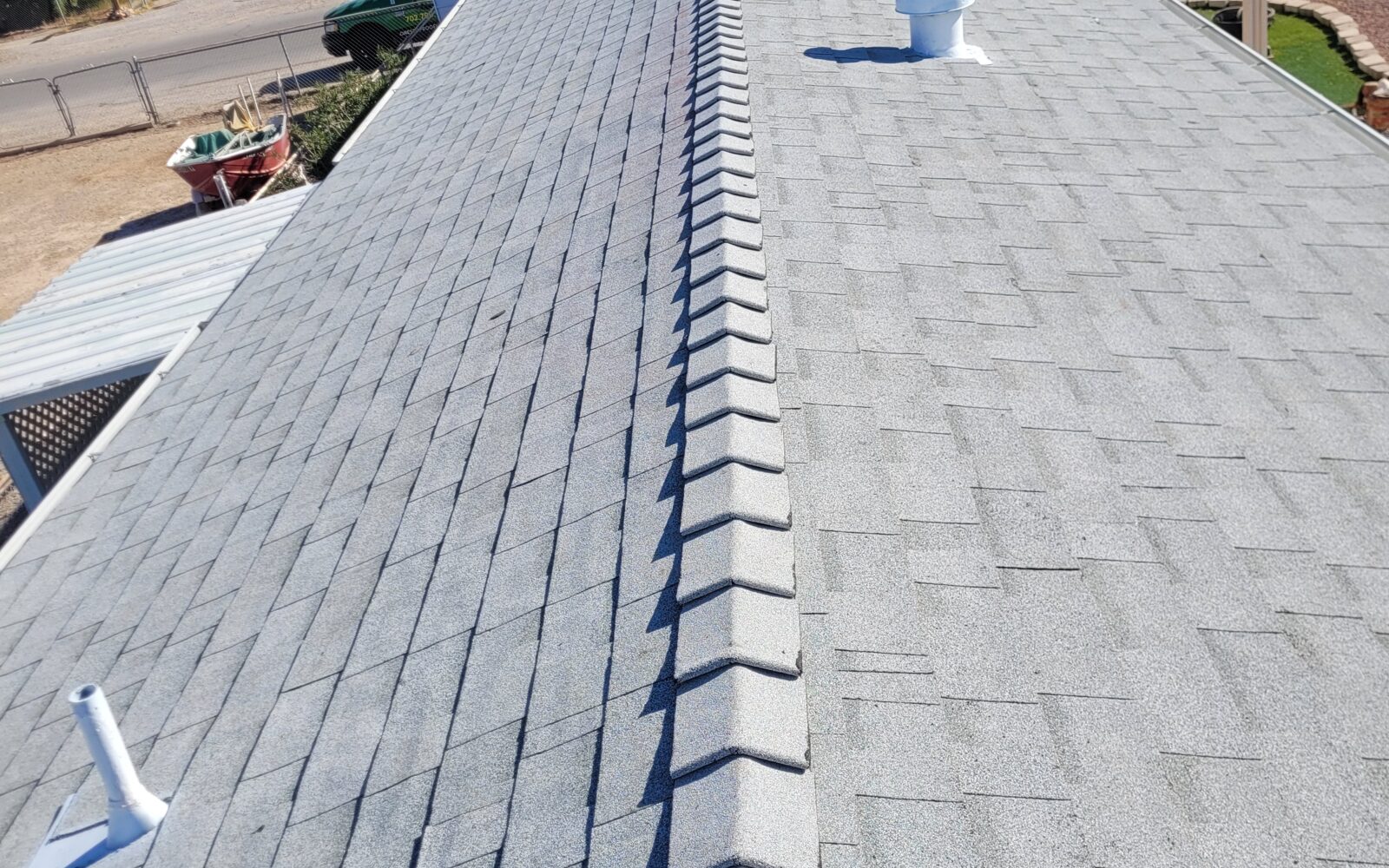
Shingle roofs appear on more commercial property than owners tend to expect. Garden apartment blocks, hotels and motels, assisted living, schools, churches, and the steep slope sections of buildings that are otherwise flat. They are also the roof type most likely to be maintained by whoever answered the phone, which is why they fail earlier than they should.
They fail in a consistent order, and knowing the order is most of what an owner needs. It tells you whether the thing in front of you is a repair, a flashing job or the beginning of a replacement budget.
How a shingle roof is held together
Each shingle is nailed along a line near its upper edge, and bonded to the course below by a strip of factory applied adhesive that softens in the sun and sets. Those two mechanisms do different jobs. The nails carry the weight; the sealant strip stops the tab lifting in wind.
The sealant strip is the one that fails. It ages, loses its bond, and once a tab is free the wind gets under it. That is why blow offs happen on roofs that look otherwise sound, and why they cluster at ridges, rakes and corners where wind pressure is highest.
Installation faults show up in the same way but much earlier. Nails driven above the fastening line hold only the top edge of the shingle. Nails driven too hard cut through the mat. Shingles laid in cold weather may never have reached the temperature needed to seal at all. A roof shedding tabs in its first few winters has an installation problem, not a maintenance one, and that distinction is worth establishing before anybody pays for a repair.
The order in which things fail
- Flashings. Valleys first, then chimney and wall abutments, then vents and skylights. All of them have shorter lives than the shingles.
- Sealant strips, producing lifted and lost tabs, concentrated at exposed edges.
- Granule loss, exposing the asphalt to ultraviolet light.
- Curling and cracking, once the exposed asphalt has hardened.
- The deck, wherever water has been getting through for long enough.
An owner who knows where their roof sits in that sequence knows what the next five years hold. A roof at stage one or two is a maintenance subject. A roof at stage four is a capital item whatever anybody patches.
Flashings are usually the actual leak
On a leaking shingle roof, the shingles are often fine. Valleys carry the water from two slopes and collect the debris from both, so they corrode or wear through first. Chimney abutments need step flashings woven into the courses and a back gutter behind the stack, which is the hardest detail on a steep slope roof and the one most often built badly.
The tell is sealant. A bead of mastic run along a wall where step flashings should be is the signature of a cheap repair, and it will fail within a few seasons. Doing it properly means lifting shingle courses back to weave metal in, which is more work, which is precisely why it gets skipped.
So when a shingle roof leaks, the first question is not how old the shingles are. It is which detail the water is coming through, and whether that detail was ever built correctly.
Reading the roof from the ground
Most of what matters can be seen without climbing, which is useful because walking a shingle roof in hot weather damages it. Shingles soften in the sun and scuff under foot, and the damage is often invisible until the following winter.
Look for lifted or missing tabs, and note whether they are scattered or clustered. Look along the ridges and the rakes, which go first. Look at the valleys for wear, debris and standing water. Check the gutters and the ground at the downpipes for granules, which is the single best age indicator available to a non specialist. And look for mismatched patches, which tell you the roof has a repair history worth asking about.
When repair stops paying
The arithmetic is straightforward and owners rarely do it. Add up what has been spent on this roof over the last three years. Then take the cost of replacement and divide it by the number of years a new roof would be expected to give.
When annual repair spending approaches that figure, patching has stopped being the economical choice. It is a budget decision at that point rather than a technical one, and the advantage of making it deliberately is that a planned replacement is cheaper and better timed than an emergency one. Weighing repair against replacement sets out the full comparison.
The other trigger is matching. Shingle colors and profiles change, and after a decade an exact match is often unavailable. On a building where appearance matters, a visible patch can force a slope replacement that the condition alone would not have required, and it is better to know that before the patch goes up.
Ventilation, and the failure nobody looks for
A shingle roof depends on the space beneath it being ventilated, and on commercial buildings that requirement is met badly more often than not. Air should enter low, at the eaves, and leave high, at the ridge, moving continuously through the roof space.
When it does not, two things happen. In summer the roof space runs far hotter than the outside air, and the shingles above it cook from below as well as above, which shortens their life measurably. In winter warm moist air from inside the building reaches the cold underside of the deck and condenses there, which rots the sheathing from the inside while the roof surface looks perfectly sound.
The symptoms are easy to misread. Shingles curling earlier than they should, sheathing that feels soft from the inside with no visible leak above it, and in cold climates ice building at the eaves. All three get attributed to the shingles, and all three are ventilation problems that a new roof will not fix unless somebody addresses them during the work.
So on any shingle roof approaching replacement, the question of ventilation belongs in the scope. Blocked soffit vents, insulation pushed into the eaves and a ridge vent that was never cut through are all cheap to correct while the roof is open and expensive to correct afterwards.
What a repair should include
- The defect located and photographed, not described in general terms.
- Replacement shingles matched for profile and as close as available for color, with the match stated.
- Any flashing in the affected area inspected and replaced if it is near the end of its life, since access is already paid for.
- Nailing to the correct line, with the fastener count stated.
- The deck checked wherever water has been getting through.
- No sealant used as a substitute for metal.
Where to go next
If the roof lost tabs in a storm and a claim is in prospect, wind damage repair covers what to document and in what order. If the roof is aging rather than damaged, the useful next step is a condition survey that gives you a remaining life estimate to plan against rather than a repair quote.
Common questions
Can a shingle roof be repaired or does it need replacing?
Both are routine, and the deciding factor is whether the failures are local or spread. Wind lifted tabs in one area, a damaged section after an impact and failed flashings are all repairs. Granule loss, curling and brittleness across whole slopes mean the shingles themselves are finished.
- Local damage in one area is a repair
- Failures appearing across all slopes mean age
- Curling and brittle shingles cannot be reliably patched
- Flashings often fail long before the shingles do
- Matching older shingles becomes difficult over time
Matching is the practical constraint owners meet first. Shingle colors and profiles change, and after a decade an exact match is often unavailable, so a repair is visible from the ground. On a building where appearance matters that can force a slope replacement rather than a patch, and it is worth knowing before the conversation starts rather than after a mismatched patch is already up there.
What causes shingles to blow off?
The sealant strip failing, almost always. Each shingle is held by nails at its top edge and bonded to the one below by a strip of adhesive that softens in the sun and sets. Once that bond fails the tab is free to lift, and wind does the rest.
- Sealant strips lose their bond as the roof ages
- Shingles installed in cold weather may never have bonded
- Nails driven too high miss the proper fastening line
- Over driven nails tear the shingle and release it
- Exposed ridges and edges lift first
Installation faults show up as early blow offs rather than late ones. Nails placed above the fastening line hold only the top edge, nails driven too hard cut through the mat, and shingles laid in cold weather never get the heat needed to seal. A roof losing tabs in its first few winters has an installation problem, and that is a warranty conversation rather than a maintenance one.
What does granule loss mean?
It means the asphalt beneath is now exposed to ultraviolet light, which is what the granules were there to prevent. Some loss is normal in the first months after installation. Bare patches on an older roof, or granules accumulating in the gutters, indicate the surface is weathering out.
- Granules shield the asphalt from ultraviolet light
- Early shedding after installation is normal
- Bald patches on an older roof are an end of life sign
- Granules in gutters and at downpipes are the easy indicator
- Exposed asphalt hardens and then cracks
Granule loss is the most reliable age indicator on a shingle roof and the easiest to check without climbing anything. Look in the gutters and at the base of the downpipes. A handful of granules on a roof that has been up for fifteen years is telling you the clock is running, and it is a better basis for a capital plan than the age of the roof on paper.
Are the flashings or the shingles usually the problem?
On a leaking shingle roof the flashings are the more common culprit. Valleys, chimney and wall abutments, dormer cheeks, vents and skylights are all weathered with metal or membrane, and those details have shorter lives and tighter tolerances than the shingles around them.
- Valleys carry the volume of two slopes and fail first
- Step flashings at walls are often omitted or done badly
- The back gutter behind a chimney is the hardest detail
- Vent and skylight collars perish before the shingles
- Sealant used instead of metal is a short term fix
Sealant where metal should be is the signature of a cheap previous repair and a reliable predictor of the next leak. A step flashing is a piece of metal woven into the shingle courses; a bead of mastic along a wall is not a substitute and will fail within a few seasons. Replacing it properly means lifting shingles back, which is why it gets avoided.
How long should a repaired shingle roof last?
The repair should last as long as the surrounding shingles do, which on an older roof may not be long. A patch on a roof with five years left is five years of service, and that is a reasonable outcome if the cost reflects it rather than being priced as a long term fix.
- A repair cannot outlive the shingles around it
- Judge the repair against the remaining roof life
- Repeated patching on an aging roof stops paying
- Flashing replacement can outlast the shingles
- Keep a record of every repair and its location
The useful test is cumulative. Add up what has been spent on this roof over three years and compare it with the cost of replacement divided by the years a new roof would give. When the repair spending approaches that figure, patching has stopped being the economical choice, and the decision is a budget one rather than a technical one.