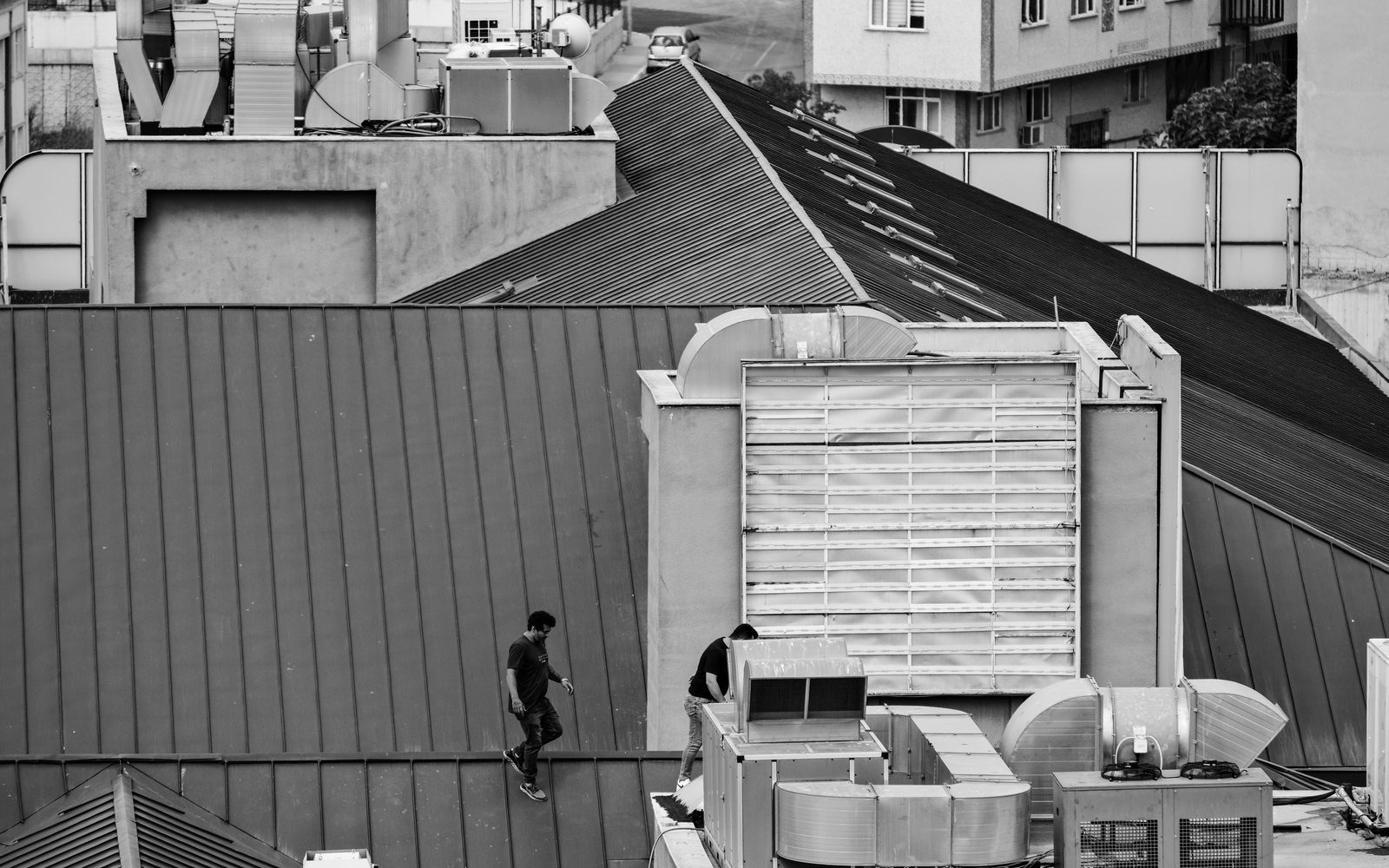
Why a metal roof fails differently from a membrane
A membrane roof is a continuous sheet with holes cut in it, and it fails where somebody cut, folded or sealed it by hand. A metal roof is a set of separate pieces held together by fixings and overlaps, and it fails at the joins and the fixings. The panel itself is usually the last thing to go.
That changes where a repair crew spends its day. On a membrane roof we probe seams and open details. On a metal roof we walk the fastener lines, run a hand along the end laps, look at the stitching down the side laps, and check every place a pipe or a bracket was driven through a rib. A roof can look immaculate from the parking lot, with straight lines and even color, and still have a fastener population that stopped sealing years ago.
It also changes what the leak looks like inside. Water that gets under a panel travels down the profile and along the purlin line, so it can appear a long way from the fault and often only in certain weather.
Movement is the thing a repair has to allow for
Metal grows and shrinks with temperature every day of its life, and a long run moves further than most people expect. That daily travel is what works fasteners loose, hardens the sealant in the laps and slackens stitching screws.
A repair that ignores it fails twice: once where it was made, and then again wherever the movement went instead. Filling an end lap solid, pinning a panel with an oversized fixing through the wrong place, or gluing a flashing rigidly across a joint all do this. The repairs that hold are the ones that keep the joint working as a joint, with a flexible material inside it and fixings that let the panel travel.
The point where refastening stops being worth it
Refastening and resealing is good value on a roof whose metal is sound. It stops being good value when the sheet has lost section, when the same laps have been opened and closed repeatedly, or when the number of fixings needing replacement approaches the number that are there.
We will tell you when the roof is at that point, even though the work that follows is a bigger decision than a repair. A roof that needs its fixings, its laps and its gutters all doing at once is not really a repair list. It is a recovery or a coating project with a repair schedule attached, and it is better priced as one.
Common questions
Should every fastener be replaced, or only the ones that have failed?
It depends whether the fasteners are all the same age. Where they are, replacing only the failures buys a short reprieve, because everything else is on the same clock.
- Original fixings on a roof of a certain age tend to fail as a population
- Washers harden and shrink with sun and heat cycling, so the sunny slopes go first
- Failures scattered across the field point to age rather than to an event
- Failures grouped at one lap or one bay point to movement or a bad detail
The sensible middle is to replace by area rather than by individual screw, taking a whole slope or a whole bay in one setup so the work is done once. Ask for the failures to be marked on a plan before that decision is made, because the pattern is the argument.
The roof only leaks when the wind blows. Is that a metal roof thing?
Very often, yes. Wind driven rain is pushed up the slope and sideways into laps and details that shed water perfectly well when rain falls straight down.
- A side lap can take water uphill when the wind is behind it
- An end lap with no sealant left relies on overlap alone, which wind defeats
- Ridge, eaves and flashing details often leak from one direction only
- A leak that follows the wind is diagnostic, so write down which way it blew
Tell us the wind direction and how hard it was raining each time water appeared. On a long roof that one piece of information can cut the search from a day to an hour, because it points at a single elevation instead of the whole building.
Is a rusted metal roof worth repairing?
It depends where the rust is and which side it started on. Corrosion on the weather face can be cleaned back and treated. Metal that has rusted through from behind is past treating.
- Rust from underneath starts where water is held: laps, valleys, gutters, under debris
- Perforation at a lap means the sheet has lost section exactly where it is joined
- Cut edges and drilled holes go first, which is why old fixing holes matter
- A magnet and a screwdriver tell you more about remaining metal than a photograph
Where enough sound metal is left, the choices run from refastening and resealing, to a coating system over a prepared roof, to a new sheet on a subframe above the old one. Where it is not left, none of those are worth buying and we will say so on the day.
Can a new sheet just be screwed down over the old roof?
It can, and done properly it is a recognized retrofit rather than a shortcut. Done badly it seals a wet roof under a new one and hides the problem for a few years.
- The existing sheet has to be sound enough to carry fixings and foot traffic
- Any wet insulation underneath has to come out first rather than be covered
- The new roof needs its own subframe, its own falls and its own edge details
- Added loading and the purlins below have to be checked by somebody qualified
It is a replacement decision rather than a repair decision, and it competes with recovering the roof in membrane or coating what is already there. What it should never be is a way of avoiding an honest look at what the old sheet is sitting on.
Why do the ends of the panels leak when the panels look sound?
Because an end lap is a joint that has to move, and the sealant inside it has a far shorter life than the metal around it.
- Long runs of metal expand and contract every day, and the laps take that movement
- The sealant hardens, loses its grip and stops bridging the gap
- Stitching screws along the lap slacken for the same reason
- Water then runs between the sheets, often a long way before it drops through
That is why sealing an end lap from above rarely holds. The joint is opened, cleaned back to clean metal, closed with a flexible tape or sealant and refixed, so it can keep moving without passing water. Expect a lap line to need attention long before the sheet does.