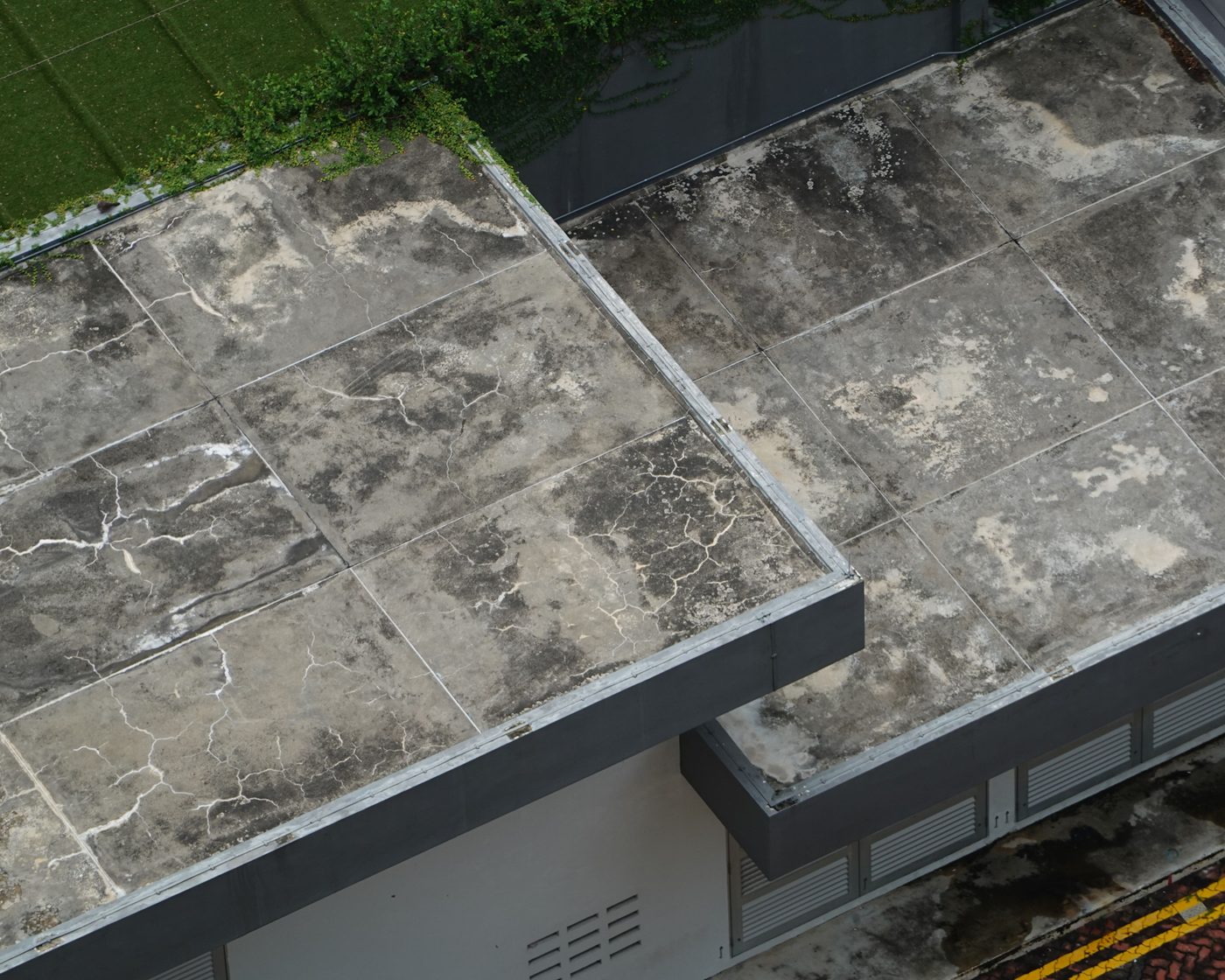
Why low slope roofs fail where they do
A flat roof is not flat. It is built with a shallow fall so that water runs to an outlet, and almost everything that goes wrong is connected to that water either arriving somewhere it should not, or failing to leave.
That gives the work a natural order. Find where water sits. Find where the sheet was joined or turned up by hand. Find every place something was driven through the roof. The open field of membrane, away from all of that, is rarely the problem and rarely needs touching.
It also explains why a roof can look sound from the hatch and still leak repeatedly. Low spots are invisible on a dry day, and the detail that is letting water in may be a long way from the stain, because water entering the assembly runs along the top of the deck before it drops through.
What we will not sell you
We will not coat a low slope roof to solve ponding. A coating follows the shape of what is underneath it, so a coated low spot is a low spot with a new surface, and on some systems standing water shortens that surface’s life. Drainage is corrected with drainage, not with a finish.
We will not patch over insulation we know is wet, and we will not pretend to know it is dry without checking. On a low slope roof the wet area is always larger than the hole, because water spreads sideways through the joints between boards.
And we will not quote a repair schedule from the ground or from an aerial photograph. Seams are assessed by hand along their length. You cannot see a lap that is about to open. You can feel it.
When people call us
Most often after a winter, when a roof that behaved all summer starts producing stains. Sometimes after a trade has been on the roof, because satellite installers, solar contractors and mechanical engineers all work up there and few of them are thinking about the membrane. Sometimes because the same area has now been patched twice and somebody wants a different answer than a third patch.
The useful time to call is when you notice water still sitting on the roof several days after rain and nothing is leaking yet. That is the roof telling you where its next leak will be, while the repair is still small.
Common questions
Does ponding water have to be dealt with before a repair?
The repair can be made under a low spot, but its life will be shorter, so the ponding is worth addressing as part of the same decision.
- Standing water sits on seams and flashings continuously rather than for minutes
- It adds weight, grows vegetation and collects silt that blocks the outlet
- Most low slope roofs hold some water after heavy rain, which is not an emergency
- Areas still wet days later, with a tide mark to prove it, are different
Correcting it ranges from clearing and resetting a drain, which is routine, to building the low area up to fall, which is real construction. We mark the low spots on a plan and say which are cheap, because if the budget covers one thing, fixing the water path protects more roof than fixing the detail.
Can the fall on a flat roof be corrected without replacing it?
In places, yes. Tapered insulation crickets or saddles can be built into a low area and covered with new membrane tied into the existing roof.
- Common around a drain set too high, or behind a wide curb that traps water
- Also in a valley between two roof sections
- A roof with no fall across its whole area cannot be corrected in isolation
- Re pitching everything means a new insulation layer over the full area
That is close to the cost and disruption of a replacement and should be compared against one honestly. There is also a middle option people forget: an additional outlet where the water already goes, rather than moving the water to the outlet you have.
Why do the laps on my flat roof keep opening?
Usually for one of three reasons, and they need different answers: a weak original weld, movement in the membrane, or water sitting on the seam.
- A seam bonded in cold or damp conditions looks sound for years then lets go
- Several seams opening together points at the original installation
- EPDM shrinks with age, pulling away from walls and curbs and stressing every seam
- A lap under a low spot stays wet far longer than one on a fall
Sealant along the edge of a seam is a symptom, not a repair. A lap that has opened needs re welding or re taping to the original method, and the reason it opened has to be established at the same time.
We are adding a rooftop unit. Can that be done without causing a leak?
Yes, but only if the roof work is treated as roof work rather than as part of the mechanical install.
- Brackets fixed straight through the membrane and sealed with mastic leak within seasons
- That detail can also end a manufacturer warranty the moment the first fixing goes through
- Done properly, the penetration is made at a curb and the unit sits on it
- Where a curb is not possible, use sleeved and flashed details to the manufacturer's method
Plan the position with drainage in mind, because a wide unit set across the fall dams water behind it. Plan the service route at the same time, with walkway pads from the hatch, because whoever maintains it will walk that line every visit for years.
Is a gravel or ballasted flat roof repaired differently?
Yes, and the difference is mostly in the time it takes. The surface has to be cleared before anyone can see the membrane, so finding the damage is a job in itself.
- Spreading, sweeping and reinstating stone adds labor to every patch
- Leak tracing is harder because the usual visual clues are buried
- A ballasted roof hides its condition, so problems are larger when found
- On a loose laid single ply roof the ballast is what holds the membrane down
Any area cleared has to be properly reinstated, and the stone cannot be left in a heap at the edge. If a contractor quotes one of these roofs at the same rate as an exposed membrane, ask how they have allowed for the surfacing.