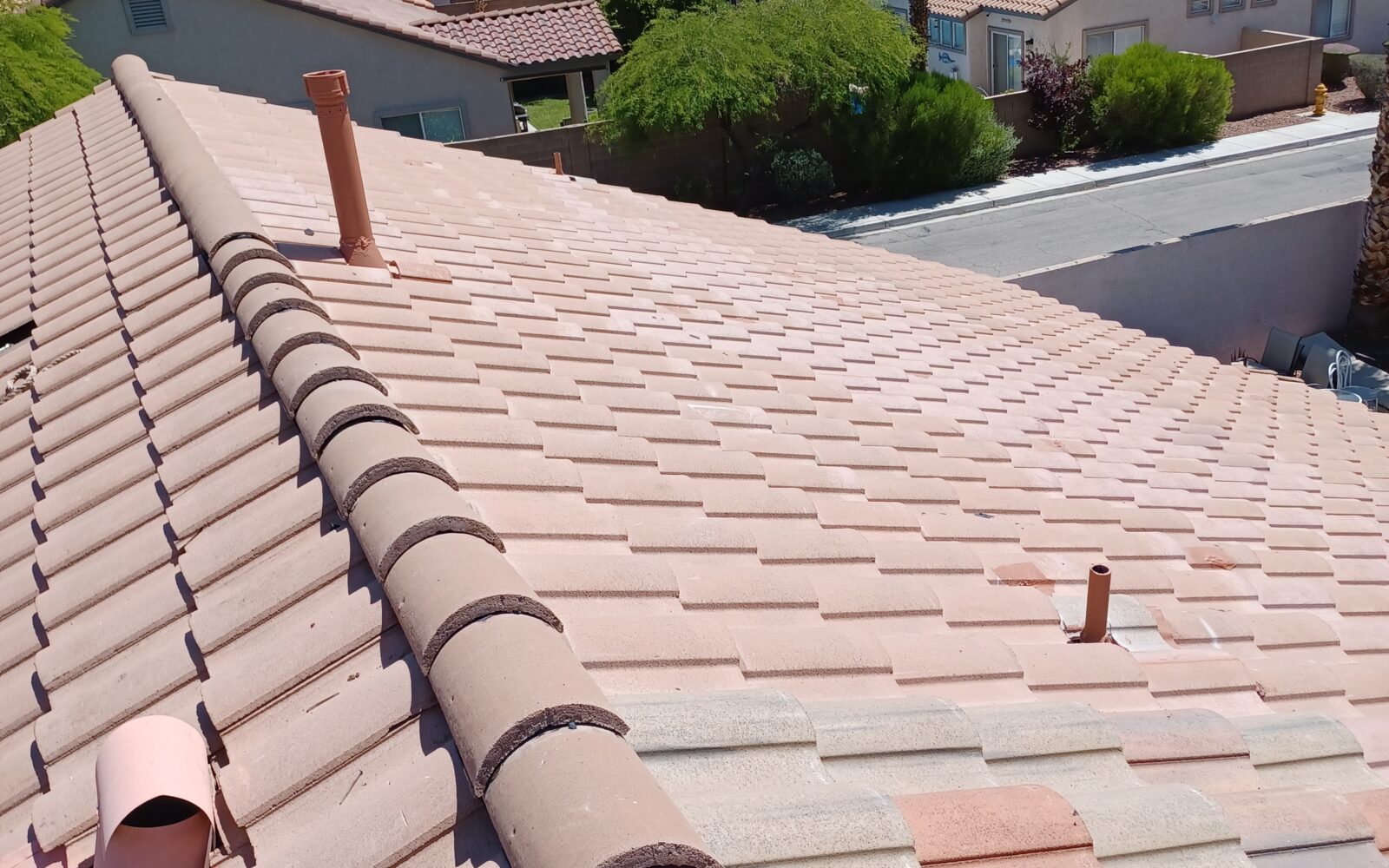
Tile roof repair goes wrong because of one misunderstanding: people believe the tile keeps the water out. It does not. The tile sheds the bulk of the weather and shields what is underneath from sunlight, and the layer underneath, the underlayment, is the waterproofing. Water gets past tile routinely, runs down the underlayment, and leaves at the eaves. A leak inside the building means the underlayment has failed, and no amount of attention to the tile will fix that.
Once that is clear, most repair decisions on a tile roof become straightforward. You are either protecting an underlayment that is still sound, or you are replacing one that is not. Everything else is detail.
What a tile roof is actually made of
From the top down, a tile roof is tile, then battens or a mortar bed holding it, then the underlayment, then the deck. On commercial and HOA property in the southwest the tile is usually concrete, sometimes clay. Both are heavy, both are brittle in the middle of a span, and both last a very long time.
The underlayment is the short lived part. It sits in the dark under the tile, which is exactly what it needs, because the thing that destroys it is ultraviolet light and heat. A tile roof in a hot climate ages from underneath in a way that is invisible from the ground.
The three repairs a tile roof actually needs
- Broken and slipped tiles. Fast, cheap, and urgent only because of what the gap exposes. Replace with a matching tile, set properly, without walking the slope.
- Flashings, valleys and penetrations. Metal fails long before tile. Valleys collect debris from two slopes and corrode or wear through. Wall abutments and chimney details need metal woven into the courses, not sealant run along the junction.
- Underlayment. The big one. Section by section where the failure is local, or a full relay where it is not.
Almost every tile roof leak traces to the second or third of those. A repair proposal that only mentions tiles is answering the wrong question.
Why the leak shows up far from the cause
Water that gets through at a ridge or a valley lands on the underlayment and runs down it. On a long slope with battens crossing the flow, it pools at a batten, finds the nail holes, and goes through the deck there. The stain inside is below that point, which can be a long way from where the water entered.
So tracing a tile roof leak means working uphill from the stain on the inside, then looking for the entry on the outside, with the slope and the batten layout in mind. That is skilled work rather than a quick look, and it is the part most often skipped. Leak detection methods sets out which tests give an answer on a tiled slope and which do not.
Mortar, and the repairs that cause the next problem
A great deal of tile roof damage is self inflicted by past repairs. Three things to look for, because all three are visible and all three mean the roof needs more than it appears to.
- Mortar fillets spread along a wall or around a chimney instead of metal flashing. Mortar cracks, then holds water against the junction it was meant to protect.
- Mortar bedded ridges that have come loose. The ridge tiles lift in wind once the bed has failed, and the usual answer is a dry fixed system rather than more mortar.
- Sealant and foam used to hold slipped tiles in place. It holds them until it does not, and it makes the proper repair harder.
The common thread is that compounds were used where mechanical fixings and metal belong. When you see them, assume the roof has a repair history and ask what else was done the same way.
Heat, dust and the desert version of this roof
In Las Vegas and the wider southwest, tile roofs take a specific kind of punishment. Surface temperatures on dark concrete tile run high for months, which cooks the underlayment underneath, and the daily swing between afternoon heat and night cooling works every fixing and every flashing lap. Dust and grit fill valleys and pack under tiles, and when the monsoon arrives the water cannot get out of the valleys fast enough.
The practical consequence is that underlayment life in that climate is at the shorter end, and valley clearing is maintenance rather than repair. A tile roof there benefits more from two visits a year than from any single repair, because the two things that kill it, exposed underlayment and blocked valleys, are both cheap to catch early.
Concrete or clay, and why it changes the repair
| Concrete tile | Clay tile | |
|---|---|---|
| Weight | Heavier, so deck capacity matters | Lighter than concrete, still heavy |
| Colour | Pigment through or on the surface, fades | Colour is the fired clay, holds for life |
| Matching later | Profiles change, fade makes new tile obvious | Easier to match, harder to source |
| Brittleness | Gets more brittle with age | Brittle from the start, consistent |
| Salvage value | Good, if handled carefully | High, often worth more than new |
The column that matters most on a repair is matching. A faded concrete tile roof will show a new tile from the street, which on a building where appearance is part of the asset turns a small repair into an argument. The answer is almost always salvage: take replacements from a hidden slope and put the new tile where nobody looks. Ask whether that is the plan before the work starts, because it has to be planned rather than improvised.
What a tile repair quote should state
- Which tiles are being replaced, counted and marked on a plan or photographs.
- Where replacements come from: new stock, salvage from this roof, or reclaimed.
- How the slope will be accessed, in enough detail to show the load is spread.
- Whether any underlayment is being renewed, and over what area.
- Which flashings and valleys were examined while access was paid for.
- That no tile will be bedded or held in sealant, foam or mortar where a fixing belongs.
That last line is worth putting in writing. It costs nothing and it rules out the repair that causes the next one.
When to repair and when to plan
The decision rule is about pattern rather than quantity. Leaks in one place, with sound underlayment visible elsewhere, is a repair. Leaks in several unrelated places, or bare underlayment showing in more than one area, says the layer under everything has reached its end, and the answer is relaying rather than another patch.
What makes that decision possible is knowing the age and condition of the underlayment, which no quote will tell you and a survey will. Repair or replace works through the same comparison for other roof types, and the arithmetic is the same here: when annual repair spending starts to approach the yearly cost of doing the job properly, patching has stopped paying.
Where to go next
If the roof has scattered broken tiles and no leaks, deal with the tiles now and stop the clock on the underlayment. If it is leaking in more than one place, the useful purchase is a condition survey that reports on the underlayment and gives a reusable tile percentage, because that is what turns a frightening quote into a budget line. And if the valleys are full, that is this month’s job, whatever else is decided.
Common questions
Does a broken roof tile mean the roof is leaking?
Not immediately. The underlayment beneath the tile is the waterproofing layer, so one cracked tile usually leaves the building dry for a while. What it does is expose that underlayment to direct sunlight, which destroys it far faster than weather alone, and the leak arrives later.
- Tile sheds water and shades the layer that stops it
- Exposed underlayment degrades in months, not years
- A slipped tile also lets wind under the courses nearby
- Debris collects in the gap and holds water there
- Replacing one tile early is the cheapest repair available
This is why a cracked tile is worth dealing with on its own schedule rather than waiting for a stain inside. The repair while the underlayment is sound is one tile and an hour. The repair after a season of ultraviolet light on bare felt is a section of underlayment, which means lifting and stacking every tile above it. The same logic applies to tiles that have slipped rather than broken, because the gap does the same thing.
How are cracked tiles replaced without breaking more?
By lifting rather than walking. The tiles in the courses above are eased up to free the broken one, the pieces are removed, the fixing is dealt with, and a matching tile is set back into the batten or the mortar bed. Weight goes on the battens, never on the middle of a tile.
- Access is by boards or staging spreading load to the battens
- The courses above are lifted, not levered or snapped
- Replacements match profile, thickness and as close as color allows
- Salvaged tile from the same roof is usually the best match
- One broken tile is rarely the only one found
The reason crews break tiles is that walking a tile roof puts a point load in the middle of a span, and concrete and clay are both brittle there. The damage often does not show on the day; the tile cracks and sits in place until the next freeze or the next storm shifts it. If a repair visit is followed by new broken tiles a few months later, that is usually what happened, and it is a reason to ask how access will be managed before anybody climbs up.
How long does tile roof underlayment last?
Far less than the tile. Clay and concrete tile commonly serve fifty years or more, while the underlayment under it is the part with a limited life, measured in decades rather than lifetimes. That mismatch is the single most important fact about owning a tile roof.
- The tile normally outlives the underlayment by a wide margin
- Heat shortens underlayment life more than rain does
- Underlayment type varies: felt, synthetic, modified bitumen
- A hot climate and a dark tile accelerate the aging
- The tile is salvaged and reused when it is replaced
It means a tile roof has a predictable mid life event that owners are rarely told about: the tiles come off, the underlayment is replaced, and the same tiles go back on. That is relaying, and it is nothing like replacement because the expensive material is already on site. Planning for it beats discovering it. If nobody knows how old the underlayment is, that question belongs in a condition survey rather than in a repair quote.
Is it safe to walk on a tile roof?
For the tiles, no, and for the person, not without equipment. Tile breaks under a point load in the middle of its span, and a tile that has just taken somebody's weight may look perfect and still be cracked. Specialists spread load onto the battens with boards or staging.
- Weight belongs over a batten, not mid span
- Boards and staging spread load across several courses
- Wet or dusty tile is slippery as well as brittle
- Concrete tile gets more brittle as it ages
- Most inspection can be done from a ladder or a drone
The practical advice for an owner is to stay off and get the roof looked at from the edge, from a ladder at the eaves, or with a drone. Those three cover most of what matters: broken and slipped tiles, debris in the valleys, the state of the ridge, and whether any underlayment is showing. Anything that needs a closer look needs somebody with staging, and that is a cost worth paying rather than a job to do yourself.
When does a tile roof need relaying rather than repairing?
When the underlayment has reached the end rather than the tile. If leaks appear in several separate places, if bare felt is visible in more than one area, or if the roof is at the age where its underlayment was always going to expire, patching individual spots stops being economical.
- Scattered leaks point at the layer under everything
- Repeated repairs in different areas say the same thing
- Relaying reuses the tile and renews what sits beneath it
- Battens, flashings and valleys are renewed at the same time
- A survey should give a figure for how much tile is reusable
Relaying is a strong outcome and owners often mistake it for replacement and panic at the quote. The building keeps its appearance, which on HOA and hospitality property is frequently a requirement, and the material cost is limited to underlayment, battens, flashings and whatever percentage of tile cannot be salvaged. Ask for that percentage in writing, because it is the number that moves the price, and ask what happens to the tile while the work is underway.