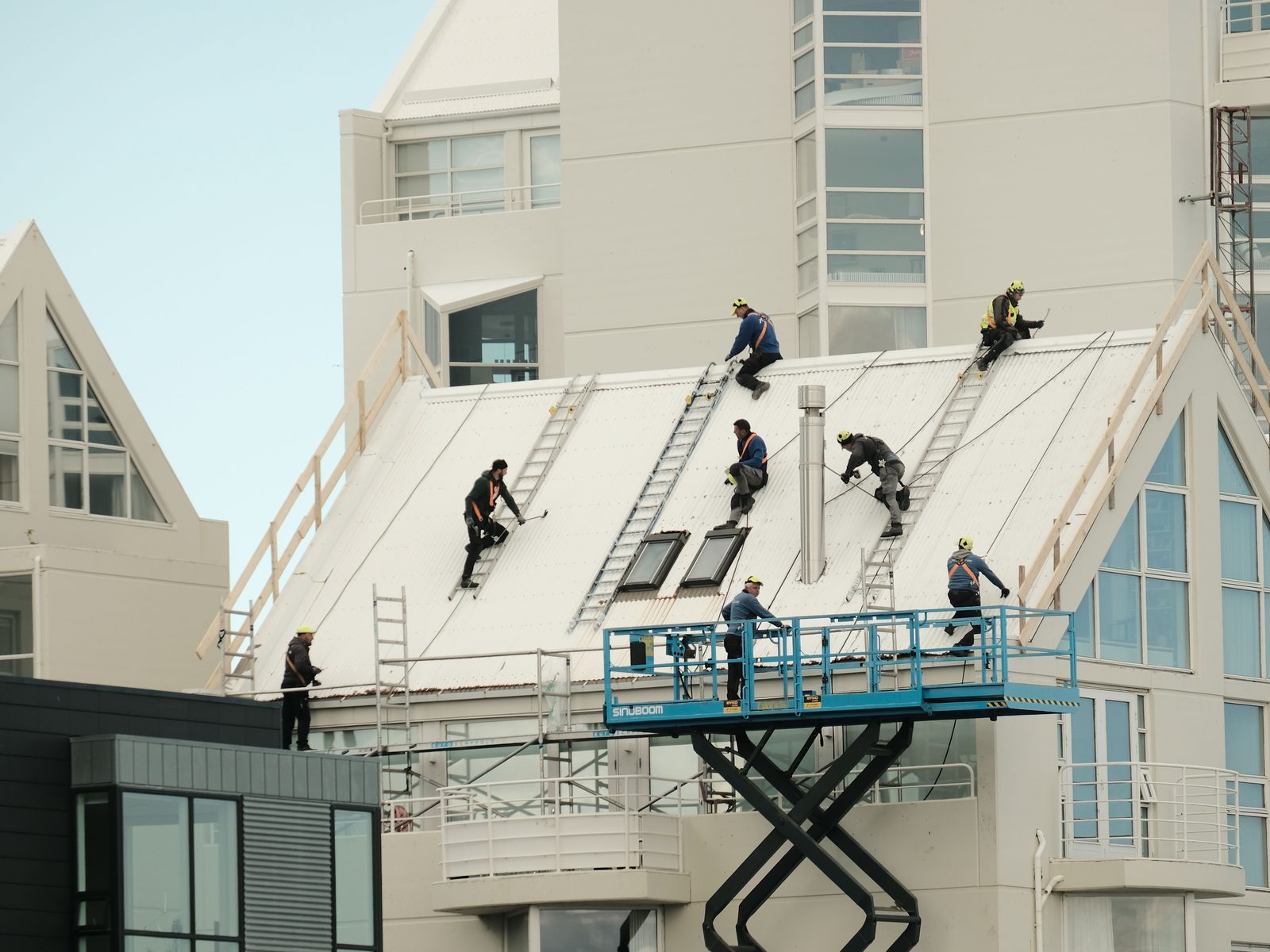
Commercial metal roofs almost never leak through the sheet. They leak at the places where the metal is interrupted or held down: the fasteners, the end laps, the side laps or seams, the flashings at walls and eaves, and everything cut into the roof afterwards. A repair therefore prices by the number of details to be put right rather than by the area of roof, which is why two quotes for the same building can describe completely different work.
That also explains why so many metal roof repairs fail. Sealant over a leaking fastener addresses the symptom and lasts until the next summer, because the movement that opened the hole is still happening. A repair that lasts deals with the reason the detail failed.
Where these roofs actually leak
| Location | Why it fails | What the repair involves |
|---|---|---|
| Exposed fasteners | Washers age, holes enlarge with movement | Larger fasteners, new washers, or refixing elsewhere |
| End laps | Sealant ages, the lap opens and water backs up | Open, clean, reseal, refix with a stitched lap |
| Side laps and seams | Poorly seamed, clips restrained, foot traffic | Reseam, replace clips, correct the restraint |
| Curbs and penetrations | Flashing formed badly, no upslope diversion | Form a proper flashing with a diverter |
| Headwall and sidewall flashings | Short laps, fixings in the water path | Reform, extend the lap, move the fixings |
| Eaves and gutters | Blocked outlets, corrosion at the cut edge | Clear, repair the edge, treat the corrosion |
| Valleys | Debris and water dammed behind it | Clear, inspect for perforation, repair the pan |
Read that list as a sequence rather than a menu. Most roofs with a chronic leak have more than one of these conditions, and whichever one is repaired first, the owner sees no improvement until the others are done too. That is the usual reason a building has been through three repairs and still leaks.
Exposed fastener and standing seam fail differently
Exposed fastener roofs are held down through the panel, which means every fastener is a hole with a washer in it. Thermal movement works those holes slightly larger over years, the washers harden and crack with ultraviolet exposure, and the roof begins to weep at hundreds of points rather than one. Repairs here are about fasteners and laps, and at some stage the honest answer is that refastening the whole roof costs more than the alternatives.
Standing seam roofs are designed to move, held by clips that let the panel slide. They fail where that movement was prevented, where a seam was not folded properly, or where somebody fixed something to the roof and pinned a panel in place. Repairs are about seams, clips and the detail that restrained the panel, and they need a crew who understand the system. Keeping a seamed panel roof serviceable is worth reading before accepting any quote that proposes screwing something through one.
Condensation, which is not a leak
A warehouse or workshop with a metal roof can drip without a single defect in it. Warm moist air inside meets cold metal, water forms on the underside of the panel and falls, and the pattern looks exactly like a leak except that it appears on clear cold mornings rather than during rain.
The tell is timing and distribution. Condensation shows up across whole slopes, is worst in the morning, and is worse in buildings with wet processes, gas heaters, open water, vehicle exhaust or high occupancy. A real leak tracks the weather and repeats in the same place.
Sealing fasteners does nothing for this, and chasing it as a leak is a familiar way to spend money on a sound roof. The remedies are insulation and a vapor control layer under the panel, ventilation, or managing the moisture being released inside. Any contractor quoting repairs on a roof that drips in dry weather should be asked which of the two they believe they are looking at, and why.
The repairs that do not last
- Mastic or tape over a leaking fastener, with the fastener left as it was.
- A new screw in the same hole, the same diameter as the one that failed.
- Sealant around a curb instead of a formed flashing with an upslope diverter.
- A patch over a corroded area with no treatment of the corrosion beneath it.
- A coating applied over wet insulation or an unsound substrate, which locks the water in.
- Any repair that fixes a standing seam panel rigidly to the structure.
Each of those is cheap, defensible on the day and back within two years, and the second visit costs more than doing it properly would have. The pattern to watch for in a quote is a price for materials and a day rate with no description of what will be done to each detail, because that is a quote for effort rather than for an outcome.
When repair stops being the answer
Three thresholds are worth knowing, and a condition survey tells you which one you are at.
- Widespread fastener failure. When the roof weeps at fasteners across whole slopes rather than in one area, repairing individual points is chasing the roof. Refastening throughout, a coating system over a prepared and dry roof, or a new skin become the real options.
- Corrosion through the panel. Surface rust at a cut edge is maintenance. Perforation, or rust at the panel ends where water sits, is section loss, and no coating restores metal that has gone.
- Wet insulation under the panels. Where the assembly is saturated, the repair is only part of the job, and a scan to map how far the water has spread should come before anybody prices the work.
A fourth consideration is not technical at all. A roof over a process that cannot be shut down, or over stock that cannot get wet, is worth repairing beyond the point where the arithmetic alone would say replace, because the disruption of a full replacement carries a cost that never appears in a roofing quote.
Where the panels are sound and the problem is age at the details, restoration is often the better value: a coating on a metal roof covers what that can and cannot do, and it is not a substitute for fixing the detail that leaks.
What a repair quote should say
- The profile, the gauge and the seam or fastener type on your roof.
- Each detail to be repaired, located and listed, not a lump sum for the roof.
- The fasteners, closures and sealants by name, including the washer type.
- How access and fall protection are arranged, and whether that is in the price.
- Whether any insulation is wet, and what is proposed for it.
- A warranty on the repair, with a term and a response time for a leak call.
Where to go next
If the leak is current and the building is taking water, emergency roof repair deals with making it safe first. If you are weighing a sequence of repairs against doing the roof once, repair or replace sets out how that decision is normally made, and metal roof maintenance covers the twice yearly walk that keeps the detail list short.
Common questions
Can a single panel be replaced in the middle of a metal roof?
On an exposed fastener roof, usually yes, because the panels unbolt and overlap. On a standing seam roof it is far harder, since each panel is locked into its neighbours along the seam, so reaching one panel means unseaming the run across to it.
- Lapped and screwed panels can be taken out individually
- Seamed panels interlock, so access runs across the roof
- Unseaming and reseaming needs the right machine
- Matching an older profile may not be possible
- Faded finishes will not match new stock
This is why damage in the middle of a standing seam roof is sometimes repaired with a cover plate or a patch rather than a new panel, which is a compromise that depends on where the damage is relative to the seam and the water path. Before accepting either, ask what happens to the clips and the thermal movement in that bay, because a repair that fixes the panel to the structure where it used to float creates a new problem that appears some years later as waviness and loose fasteners.
How do you find a leak on a commercial metal roof?
By following the water path upslope from the stain inside, then testing the details above it. Water on a metal roof travels along laps, seams and purlin lines before it drops, so the entry point is routinely well away from the wet spot on the ceiling.
- Start inside and work up the slope, not down
- Suspect every penetration above the stain first
- Check end laps, seams and headwall flashings in that run
- Water testing one detail at a time isolates the cause
- Trapped water in insulation spreads the evidence
On a roof with insulation under the panels or a liner below, the water can run a long way inside the assembly, which is why a scan for trapped moisture is often worth more than another visual pass. Isolating the cause matters more on metal than on membrane because the obvious candidates are numerous: a roof can have thousands of fasteners and dozens of laps in the area above one stain. A methodical test that rules each out in sequence costs a visit and saves a sequence of failed repairs.
Is a repair on a metal roof over purlins different from one over a deck?
Yes, in two ways that affect the price. Over purlins there is nothing solid behind the panel, so fixings must land on structure and anybody working up there needs fall protection with no walkable surface beneath. Over a deck there is support, and usually insulation that can be wet.
- Fixings have to hit purlins, which must be located first
- Access and fall protection cost more over open purlins
- A liner panel or insulation hides the leak path
- Over a deck, wet insulation may need replacing too
- Condensation is a common cause in both assemblies
The second point is the one owners underestimate. On a warehouse with open purlins, the crew cannot simply walk and kneel where they like, and the safe working arrangements can cost more than the materials in a small repair. It is also why several small repairs are better combined into one visit. Where the assembly includes insulation, ask whether any of it is wet, because leaving saturated insulation under a new patch keeps the structure corroding quietly where nobody can see it.
What should be done about a leaking curb or skylight on a metal roof?
Treat the detail as the repair rather than sealing around it. Curbs, skylights and units cut into a panel roof leak because the flashing was formed badly, fixed through the water path or sealed with mastic that has aged, and more sealant on top of that lasts one season.
- A curb needs a formed flashing, not a bead of sealant
- Upslope diverters matter as much as the downslope lap
- Fasteners through a water path will leak eventually
- Aged skylight panels often need replacing, not patching
- Factory made curb flashings exist for most profiles
The upslope side is where most curb repairs fail. Water arriving at a curb has to be diverted around it, and a flashing that only laps correctly on the downslope side dams water above the obstruction until it finds a fastener. Where a unit is being replaced anyway, that is the moment to reform the curb properly rather than reuse a detail that has already failed once. Plastic skylight panels also go brittle with ultraviolet exposure, and a brittle panel cannot be sealed back into service.
Who should repair a metal roof on a commercial building?
A contractor who works on panel roofs regularly and can name the profile on yours. Metal roof repair is sheet metal work: forming flashings, matching profiles, understanding where a panel has to be free to move. A membrane crew and a shingle crew do neither of those things.
- Ask what the profile and the gauge on your roof are
- Ask to see flashings they have formed themselves
- Check they carry the right fasteners and closures
- Confirm fall protection for an open purlin roof
- Ask what warranty the repair carries, in writing
The profile question is a quick filter. A contractor who identifies the panel, the seam type and roughly when that profile was current has worked on these roofs; one who describes it as corrugated has not. Ask what they intend to use at each fastener, because a repair that reuses the existing holes with the same size screw will be back, and the answer should involve larger diameter fasteners with new washers or a different fixing position altogether.