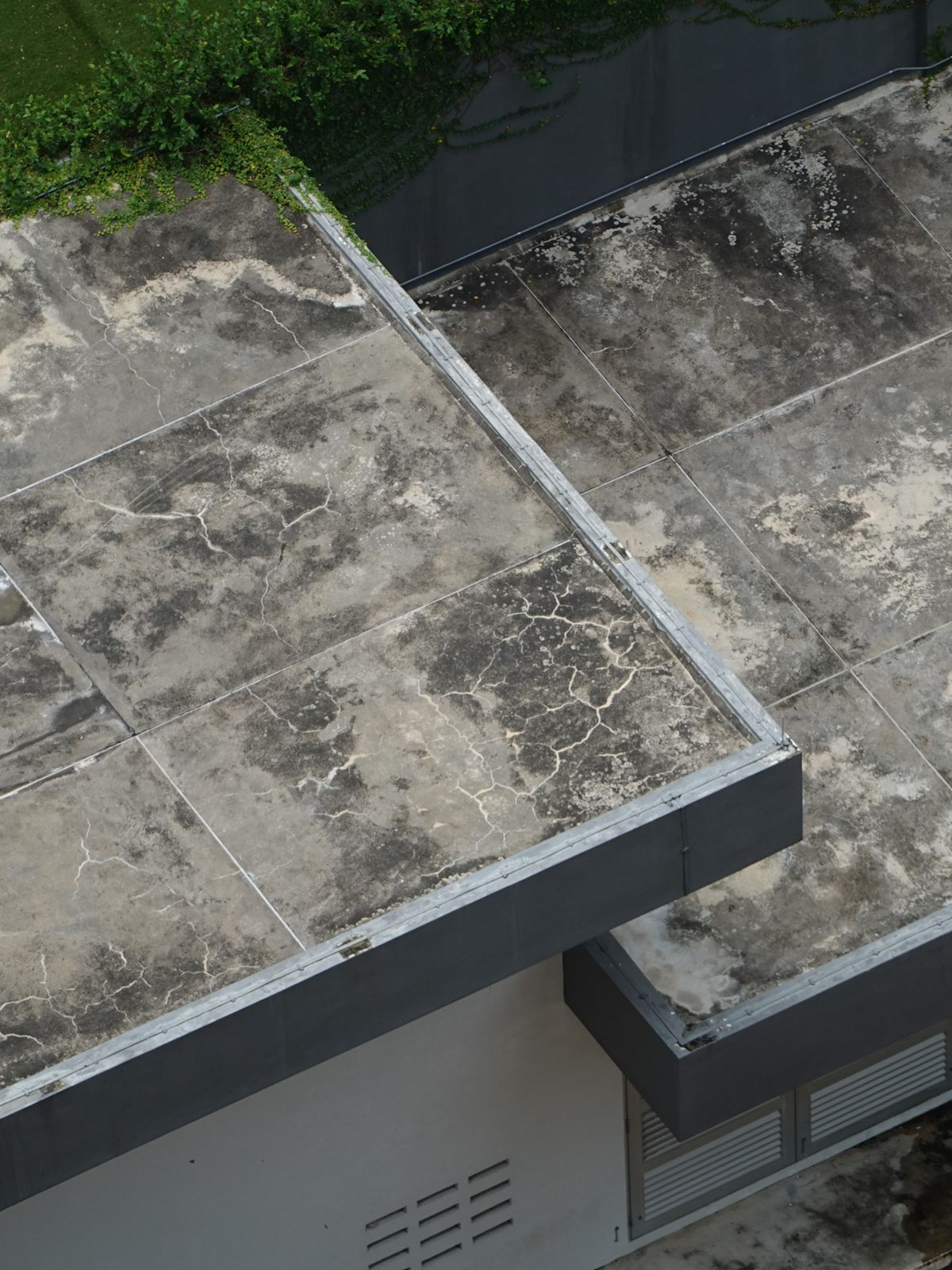
A roof leak repair has two parts: finding where the water enters, and fixing the cause so it does not come back. The first part is usually the hard one, because water almost never drips through the ceiling directly below the hole that let it in.
That gap between the hole and the stain is why leaks get repaired three times before they stop. A contractor is called, patches the membrane above the ceiling tile, invoices, and the next heavy rain produces the same drip. This guide covers what to do in the first hour, where leaks actually start on a flat or low slope roof, how a competent crew traces one, and what a repair has to include to hold.
In the first hour
- Move people, equipment and stock away from the drip
- Catch water with buckets and protect floors with plastic sheeting
- Switch off electrical circuits below the leak if water is near a fitting or a light
- Photograph the stain, the drip and any damaged contents before you clean anything
- Note the time, the weather, the wind direction and how heavy the rain was
- Lift a ceiling tile if it is safe, so you can see where the water is running above
- Call a roofer for a temporary repair once it is safe to go up
Those notes matter more than they look. The pattern of a leak is diagnostic information: a drip that starts within minutes of rain beginning behaves differently from one that starts after an hour, and a leak that only appears in wind from one direction points somewhere specific. Write it down while you remember it.
What you should not do is go onto the roof in the weather. A wet membrane is slippery, storms bring lightning, and damage hides under standing water.
How water travels inside a roof
Water entering a roof rarely falls straight down. It arrives at the top of the deck and then goes wherever the structure lets it.
On steel decking it runs along the flutes, which can carry it a long way in one direction before it finds a gap at a joint, a fastener hole or a penetration. On timber it follows the boards and the joints between them. On concrete it spreads more slowly and more widely, which makes it harder to trace, not easier. Above the deck, water moves sideways through the joints between insulation boards, soaking the material as it goes.
Three things follow from this. The entry point is almost always upslope of the stain. The wet area inside the roof is always larger than the hole that caused it. And the stain on the ceiling marks the lowest opening in the deck, not the fault in the roof.
Where leaks usually start
- Flashings at walls, curbs and parapets, where the membrane is turned up and terminated by hand
- Penetrations such as pipes, vents, conduit and equipment supports, each of which is a hole in the roof sealed with a detail
- Drains that are clogged, cracked or have failed clamping rings, so water backs up above the level of the flashings around them
- Seams that have opened, lifted or were never welded properly in the first place
- Punctures from foot traffic, dropped tools, storm debris or a technician servicing a rooftop unit
- Perimeter details where the membrane meets the edge, the coping or the gutter line
The pattern is consistent: leaks begin where the roof meets something else. The open field of a membrane, laid flat by machine and left alone, rarely fails first. The details are cut, folded and sealed by hand, and handwork is where failure starts. It is also why the number of penetrations on a roof predicts its leak history better than its age does.
How professionals trace a leak
The method is always the same in principle. Start at the stain, establish which way the deck runs, work uphill against the fall, and inspect every detail on the way. What varies is how much technology is needed when the visual search comes up empty.
| Method | What it finds | When it is used |
|---|---|---|
| Visual inspection uphill | Open seams, punctures, failed flashings, blocked drains | Always first. Finds most leaks on most roofs |
| Moisture meter | Wet insulation under an intact membrane | To map how far the water has spread and where to cut |
| Infrared survey | Warm wet areas that hold heat after sunset | On large roofs where the entry point is not obvious |
| Controlled water test | The specific detail that leaks, by flooding one area at a time | On stubborn leaks, working uphill in stages |
| Electronic leak detection | Breaches in the membrane, by tracing current through them | On roofs where the membrane can be flooded or scanned |
| Core sample or test cut | What the assembly is actually made of and how wet it is | To confirm before a large repair or a coating job |
A water test deserves a note, because it is the most misused technique on this list. Done properly, one small area is flooded at a time, starting at the bottom and moving up, with someone watching inside. Done badly, the whole roof is hosed at once, everything gets wet, and nothing is learned except that the roof leaks, which you already knew.
Tracing takes time, and on a large or complicated roof it can take a day. Paying for it is cheaper than paying for three repairs in the wrong place.
Not every leak is a leak
Before anyone opens the roof, rule out the alternatives. Water on a ceiling can come from condensation on cold pipework or ductwork, from a failed air conditioning condensate tray, from a plumbing run in the ceiling void, or from a window or wall detail above.
Condensation is the common one on commercial buildings and it has a signature. It appears in cold weather rather than wet weather, it often shows as damp over a wide area rather than a defined drip, and it tends to follow the line of a duct or a steel beam. A roof leak follows the rain. If the ceiling is wet on a dry, cold morning, the roof is probably not the cause, and cutting into it will not help.
Fixing it properly
A lasting repair does three things: it matches the existing membrane, it removes the water already in the roof, and it fixes the cause rather than the hole.
Matching matters because membranes are not interchangeable. A PVC patch will not weld to a TPO roof. An EPDM repair needs the right tape and primer. A modified bitumen patch needs a compatible adhesive. Using the wrong material produces a repair that looks finished and fails within a season.
Removing the water matters because wet insulation keeps feeding moisture into the building long after the roof surface is sealed, and it never dries out on its own under a membrane. If the insulation under the leak is soaked, it gets cut out and replaced. Sealing over it guarantees a second visit.
Fixing the cause is the part most often skipped. Ask what caused it. A puncture with no explanation usually means foot traffic, and the real fix includes walkway protection on the route to the rooftop plant. A seam that opened means the surrounding seams need probing too. Water standing in the same place for days means drainage, and no patch survives that for long. Our guide to commercial roof repair sets out how a good repair visit runs from start to finish.
What you should get afterwards
A repair you can rely on comes back with evidence:
- Where the water entered, and how the crew established it
- Photographs of the area opened up and what was found underneath
- Whether the insulation was wet, how it was checked, and how much was replaced
- What materials were used and whether they are compatible with the membrane
- Whether the repair is permanent or temporary, stated plainly
- What caused the failure and what stops it recurring
An invoice that says “attended site, repaired leak” gives you none of that. It is also useless in an insurance claim, in a warranty claim and in the next negotiation with a tenant, all of which turn on cause.
Emergency attendance, and what it buys
When water is entering an occupied building, the first job is to stop it, and that work is temporary by design. In rain or cold, adhesives will not bond and membranes will not weld, so an emergency crew uses mechanically fastened patches, temporary sheets, sealant tapes or a tarpaulin dried in at the edges. Those hold the water out until conditions allow a proper repair.
That is a legitimate step, not a shortcut, and it should be described and priced as temporary. The failure to watch for is emergency work billed as a permanent fix and then forgotten. If the roof is patched in bad weather, agree in writing that the contractor returns, and agree when. Temporary work left in place is next winter’s leak, usually in the same spot and usually worse.
What a leak is doing while you wait
A leak that produces one slow drip looks like a small problem, and the visible drip is the least of it. Four things are happening above the ceiling.
- The insulation is getting wet, and it spreads sideways from the entry point. Wet insulation stops insulating, so heating and cooling costs rise quietly, and it will not dry out under a membrane.
- The deck is taking water. Steel decking corrodes from the top down where it stays wet, and timber decking softens. Both turn a membrane repair into a structural one.
- The wet area is growing, which means the cost of the eventual repair grows with it. A leak reported in the week it starts is usually a surface repair. The same leak after a season often means cutting out and replacing material over a much wider area.
- The building is getting damp. Ceilings, insulation, stock and finishes absorb it, and persistent damp in a void invites mould and the remediation cost that follows.
There is also a paperwork consequence. Most manufacturer warranties require that damage be reported promptly, and an owner who waits months before calling anyone can find the cover gone by the time they do.
Stopping the next one
Most leaks are predictable. Blocked drains, lifted laps, split pipe boots, loose fasteners and damage from the technicians who service rooftop units account for a large share of what floods commercial buildings, and every one of them is visible to anyone who walks the roof twice a year and clears the outlets.
That is the case for a maintenance program in one sentence: the same defect costs a fraction to fix before it lets water in. Controlling who goes on the roof, and keeping a log of it, prevents most of the rest.
If the membrane is aged but the insulation is still dry, the longer term answer may be restoration or a coating rather than a running battle with individual leaks. If the roof leaks in a new place every month, it is telling you something else, and the honest next step is to price a replacement rather than another patch.
Water coming in now? Deal with the first hour above, then get the leak traced properly. Planning ahead instead? Start with roof maintenance.
Common questions
Why is the leak far from the stain?
Because water travels before it drips. It enters at a hole or an open detail, runs sideways along the top of the deck, and falls through the first opening it finds.
- It follows a seam, a flute in steel decking or a joint between insulation boards
- On steel decking the entry point is almost always upslope, the way the flutes run
- On a concrete deck it spreads more evenly and is harder to trace
- A patch directly above the ceiling stain is usually patching sound material
That is why so many repairs fail, and why leak tracing takes time that is real work rather than padding on the invoice. The honest method is to start at the stain, work uphill against the fall, and test the suspects rather than guess at them.
Should I go on the roof during a storm?
No. A wet low slope roof is slippery, storms bring lightning and wind, and a damaged roof may have hidden holes or a weakened deck under standing water.
- Nothing you can do up there during a storm is worth the risk
- Protect the inside instead: move people and stock, catch the water, sheet the floor
- Switch off electrical circuits below the drip if water is near a fitting
- Photograph everything as it happens, with the date and the weather noted
Those photographs are what an insurer or a warranty provider will ask for later. If water is entering fast enough to threaten the building, call for an emergency attendance and say clearly that it is an active leak. When the weather clears the roof still needs a proper inspection.
Why does my roof only leak in heavy rain?
Because the defect is small enough that light rain drains away before it finds the opening, and because heavy rain overloads the drainage.
- A blocked or undersized outlet backs water up above a flashing or a lap
- Water then enters over a detail that is sound in ordinary weather
- Driven rain pushes water sideways into laps, vents and wall junctions
- A leak starting within minutes is a direct opening, one starting later is a backup
Tell the roofer what the weather was doing each time, including the wind direction and how long the rain had been falling before the drip started. An intermittent leak is not a small leak, it is one that needs a particular condition to show itself, and it does the same damage in between.
Does insurance cover a roof leak?
It depends on the cause. Most commercial property policies cover sudden and accidental damage and exclude gradual deterioration, wear and tear and failure to maintain.
- A storm tearing off flashing or debris punching through the membrane is usually covered
- A roof that has simply worn out is usually the owner's cost
- Documentation decides it: the date, the weather event, photographs, a maintenance record
- Stock, fittings and business interruption are often covered where the roof repair is not
Read your own policy wording rather than relying on general advice, tell the insurer early, and do not let anyone strip evidence off the roof before it has been recorded. Emergency work to prevent further damage is normally expected of you, so do it and keep the invoice.
Is a roof leak the landlord's or the tenant's responsibility?
The lease decides it, not custom. In most commercial leases the structure and the roof sit with the landlord, and the tenant holds the interior and anything they installed.
- Full repairing and insuring leases move much more onto the tenant, sometimes the roof
- Responsibility usually follows tenant equipment: a unit, a kitchen extract, a dish
- The same applies to damage from a tenant's contractors servicing their plant
- Control roof access, so there is a record of who went up and when
Get the leak traced and photographed before anyone starts negotiating, because the cause determines who pays and an undocumented leak becomes a matter of opinion. Whoever ends up paying, the water needs stopping first, and both parties normally benefit from agreeing that separately.