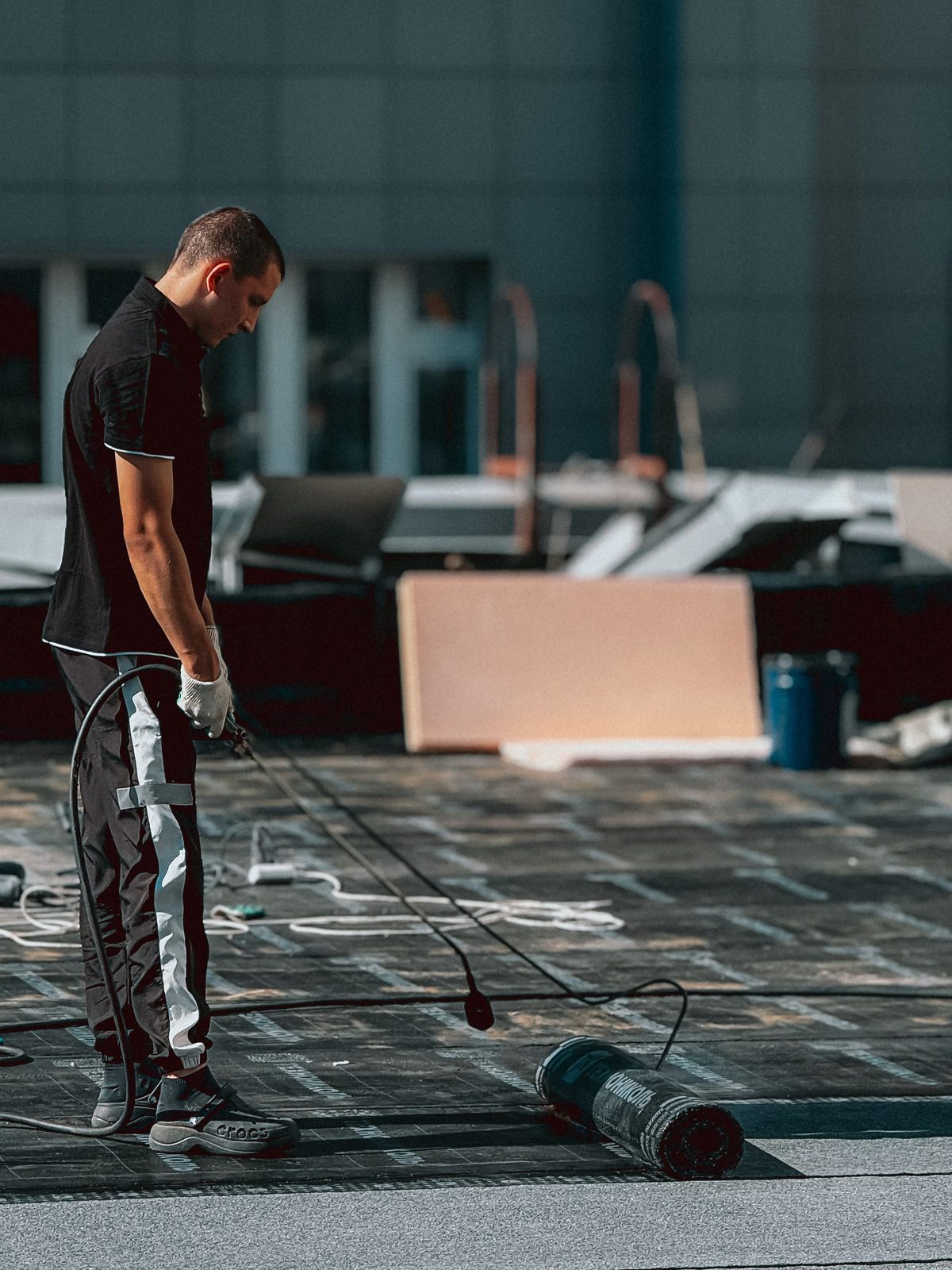
Roof maintenance is the routine work that keeps a roof watertight between replacements: inspecting it, clearing the drains, and fixing small problems before they become leaks. It is the cheapest way to extend a roof’s life, and it is the work most owners skip.
The reason it gets skipped is simple. A roof that is working looks exactly like a roof that is about to fail, from the only place most owners ever see it: the ground. There is no warning light. The first signal is usually a stain on a ceiling tile, and by then the cheap window has closed.
This guide covers what a maintenance visit actually does, how often a roof needs one, what a plan should contain, and how to judge whether the one you are paying for is worth it.
What a maintenance visit covers
- Drains, gutters and scuppers: cleared of leaves, debris and silt, and checked for flow
- Membrane field: checked for splits, blisters, punctures and worn surfacing
- Seams: probed for gaps and lifting edges, which is done by hand rather than by eye
- Flashings: walls, curbs, pipes and edge metal checked for gaps and failed sealant
- Rooftop equipment: access panels closed, condensate lines draining clear of the membrane, no debris or fixings left by other trades
- Walkways and traffic areas: checked for wear where people actually walk
- Interior: ceilings checked for new stains that point to leaks nobody has reported
The order matters less than the thoroughness. The single most valuable item on that list is the drains, because standing water is the condition that turns a minor weakness into a leak.
How often
| When | What to do |
|---|---|
| Spring | Full inspection, clear winter debris, check for storm and freeze damage |
| Summer | Check for heat and ultraviolet wear, and for ponding that has not drained after rain |
| Autumn | Full inspection, clear leaves before winter, confirm every drain runs |
| After a storm | Walk the roof for punctures, lifted metal, displaced equipment and blocked outlets |
| After any trade works on the roof | Check what they left behind and whether they cut anything |
That last row catches more damage than owners expect. Satellite installers, solar contractors, mechanical engineers and window cleaners all go onto roofs, and few of them are thinking about the membrane. A dropped tool, a dragged ladder or a bracket fixed straight through the roof will not announce itself.
Ponding water, and why it matters more than it looks
Most flat roofs are not flat. They are built with a slight fall so water runs to drains, gutters or scuppers, and they are designed to clear within about forty eight hours of rain stopping.
Water still sitting after that is a problem for three reasons. It adds weight, and a large pond is a lot of weight on a structure that may not have been designed for it. It accelerates ageing of the membrane and the surfacing beneath it. And it sits over seams and details, which is precisely where roofs are weakest, applying pressure day after day until something gives.
Ponding is also diagnostic. A pond that appears in a new place is telling you the deck has deflected, the insulation beneath has compressed, or a drain has partly blocked. On a maintenance visit the pond is worth photographing and mapping, because its position over time is a record of how the roof is changing.
Keep records, and keep them the same way every time
Photograph the same areas from the same positions on every visit. Number the areas and keep the numbering consistent. Date everything.
A dated photo log does four jobs. It shows how the roof is ageing, which turns guesswork into a trend. It proves the maintenance a warranty requires. It supports an insurance claim by showing the condition before an event. And during a sale or refinance it answers the question a buyer’s surveyor will ask, which is not “is the roof sound” but “can you show me”.
Keep the log somewhere that survives staff turnover. The commonest reason a building has no roof history is not that nobody did the work. It is that the person who held the file left.
What a maintenance plan should contain
Before signing anything, get clear answers on five points.
- Visit frequency, and whether after storm visits are included or charged.
- What minor work is included in the visit price. Clearing drains, resealing a lap, replacing a fastener: these should be done while the crew is on the roof, not quoted as a return visit.
- What counts as major work, and the rate for it.
- What the report contains. Photographs, a condition summary and a list of recommended work with priorities. A one line email is not a report.
- Whether the contractor is authorized to work on your roof under its warranty.
Watch for the plan that is an inspection dressed as maintenance. If every finding comes back as a separate quote, you are paying someone to generate work rather than to prevent it.
Budget forecasting: the part worth paying extra for
The most useful thing a maintenance contractor can give you is not this year’s report. It is a three to five year view of what the roof will need and roughly when.
That turns roof spend from an emergency into a line in a budget. It tells you whether you are funding small repairs on a roof with years left, or feeding a roof that needs replacing, which is a very different conversation with whoever approves capital. Our guide to repair versus replacement sets out the decision rules, and restoration covers the middle option when the membrane is tired but the insulation is dry.
Maintenance is not the same on every roof
The inspection list above applies everywhere. What the crew spends its time on does not.
| System | Where it needs attention | The failure to catch early |
|---|---|---|
| TPO and PVC | Welded seams, flashing laps, corners at curbs | A seam that has started to open. Probed by hand, it is a small reweld. Left, it is a wet roof |
| EPDM | Perimeter and upstands, seam tape, pipe boots | Shrinkage pulling the membrane away from walls, which shows at the edges long before it leaks |
| Modified bitumen | Laps, blisters, granule loss, torch detail at penetrations | Lifted laps, which reseal cheaply while the adhesive is still sound |
| Built up | Gravel distribution, blisters, flashing at the perimeter | Bare patches where gravel has migrated, exposing the plies to ultraviolet |
| Metal | Fasteners, washers, panel end laps, penetrations | Backed out fasteners and perished washers. Almost every metal roof leak starts at a fixing |
| Green and ballasted | Drainage layers, outlets, root barrier at upstands | Blocked outlets hidden under planting or ballast, which nobody sees until water backs up |
The practical point is that a contractor who works on your membrane type every week knows where it fails, and will spend the visit there. One who does not will spend it walking the field and finding nothing.
What it costs and how it is priced
Maintenance is usually priced per visit, with the rate driven by roof area, access and how many penetrations there are to inspect. Access is the same lever it is on repair work: a roof reached by an internal stair and hatch is far cheaper to service than one needing a lift or a route through a tenant’s space.
Three things are worth checking in any quote.
Is minor corrective work included, or extra? This is the difference between a plan that prevents problems and one that reports them. Clearing drains, resealing a lap, replacing a backed out fastener and closing an open access panel are minutes of work when the crew is already up there. If every one of those returns as a separate quote, the plan is a sales channel.
Is the after storm visit included? Storm damage is the event most likely to need an urgent response, and it is the visit most likely to be excluded from the headline price.
How many buildings are on the contract? If you have several properties, servicing them under one agreement spreads the mobilization cost and usually lowers the per building rate.
Compare quotes on scope rather than on the number. Two plans at the same price can differ by everything that matters, and the cheaper one is often cheaper because the useful work has been moved into the extras column.
Controlling who goes on the roof
Most avoidable damage on a commercial roof is not caused by weather. It is caused by people who had a reason to be up there and no reason to care about the membrane.
Three controls make a real difference, and none of them cost anything.
- A single point of authorisation. Nobody accesses the roof without the facilities manager knowing. A locked hatch is the simplest version of this.
- A visit log. Date, company, reason, and who let them up. When a leak appears, the log is how you connect it to the solar survey three weeks earlier.
- Designated walkways. Pads or protection boards on the routes people actually take to reach plant. Foot traffic on an unprotected membrane, especially in cold weather when it is stiff, is one of the commonest causes of punctures.
Add a fourth if you have rooftop plant under service contracts: tell the mechanical contractor in writing that they are responsible for damage they cause. It changes behavior.
When maintenance is not enough
Maintenance has reached its limit when any of these is true.
- The same area keeps leaking after being repaired more than once.
- A moisture survey finds wet insulation over a meaningful share of the roof.
- The membrane is brittle, crazed or shrinking across the field rather than in one place.
- Annual repair spend has started to look like a meaningful share of replacement cost, and the trend is rising.
At that point maintenance is still worth doing, because the roof has to survive until the money is available, but it is holding a line rather than extending life. The decision has moved to restoration or replacement, and the honest maintenance contractor will tell you so rather than keep selling visits.
The short version
Two inspections a year, a walk after every storm, drains kept clear, small failures fixed while they are small, and a photo log that anyone can pick up. That is most of it. The roofs that fail early are almost never the ones that were unlucky. They are the ones nobody looked at.
Leaking now rather than planning ahead? Start with finding and fixing roof leaks. Wondering whether a coating buys you time? Read about roof coatings.
Common questions
How often should a commercial roof be inspected?
Twice a year as a minimum, once in spring and once in fall, plus a walk after any major storm.
- Spring catches winter damage before the rain season arrives
- Fall clears leaves before they block the drains
- Roofs fail slowly through weather and ultraviolet exposure, which a seasonal visit catches
- They also fail suddenly through impact or blocked drainage, which a storm walk catches
- Heavy equipment, frequent trades access or many penetrations justify quarterly attention
On roofs with kitchens, grease exhaust, solar arrays or regular contractor access, most damage is caused by people rather than weather, and people arrive year round. If the roof is under a manufacturer warranty, check the wording, because many require documented inspections at a stated frequency.
What does a roof maintenance plan include?
Scheduled inspections, drain and debris clearing, minor repairs to seams and flashings, a photographic report after each visit, and a running record of the roof's condition.
- Major repair work is normally quoted separately
- The weakest version is inspection only: somebody walks the roof and sends a list
- A useful plan includes the small corrective work in the visit price
- The strongest version adds a budget forecast for the years ahead
Lifted laps, loose fasteners and failed sealant should be fixed while the crew is up there rather than becoming a second visit. Read the scope, ask which version you are buying, and ask the hourly rate for work outside it.
Is roof maintenance worth the cost?
It is the cheapest money you will spend on the roof. Maintenance costs a small fraction of replacement each year, and it catches failures while they are still repairs.
- The expensive case is a leak that ran unnoticed for a whole season
- A blocked drain is a few minutes of work
- Left blocked, it puts standing water over a seam, and water finds every weakness
- Water in the insulation spreads sideways, so the wet area dwarfs the entry point
Wet insulation cannot be dried, it has to be cut out and replaced, and that is the jump in cost maintenance prevents. A documented history also supports warranty claims, supports insurance claims, and gives a buyer or lender confidence during due diligence.
Can I do roof maintenance myself?
Only the part that needs no roof work. Everything on the roof surface itself should be left to a roofer.
- Check ceilings for new stains
- Look at downpipe outlets during rain to see whether the drains are running
- Keep a record of who has been on the roof
- Neither reason for staying off is about skill: it is safety, and it is damage
- If staff do go up, insist on designated walkways and a log of every visit
A commercial roof means working at height near edges, skylights and rooftop plant, which needs training and equipment. Foot traffic is one of the commonest causes of punctures, so a well meaning inspection can create the leak it went up to prevent.
What happens if a roof is never maintained?
It fails early and it fails expensively, because the failures that shorten a roof's life are small, cheap to fix and invisible from the ground.
- Drains block, so water stands
- Standing water works at seams and flashings until one opens
- Water enters the insulation and travels, so the wet area is large before any stain
- Meanwhile ultraviolet exposure ages the surfacing and nobody has looked at it
A roof designed for twenty years can lose a meaningful share of that life, and the replacement bill then includes stripping saturated insulation and sometimes repairing the deck. There is a paperwork cost too: a warranty with a maintenance requirement is void, and an insurer will ask when the roof was last inspected.