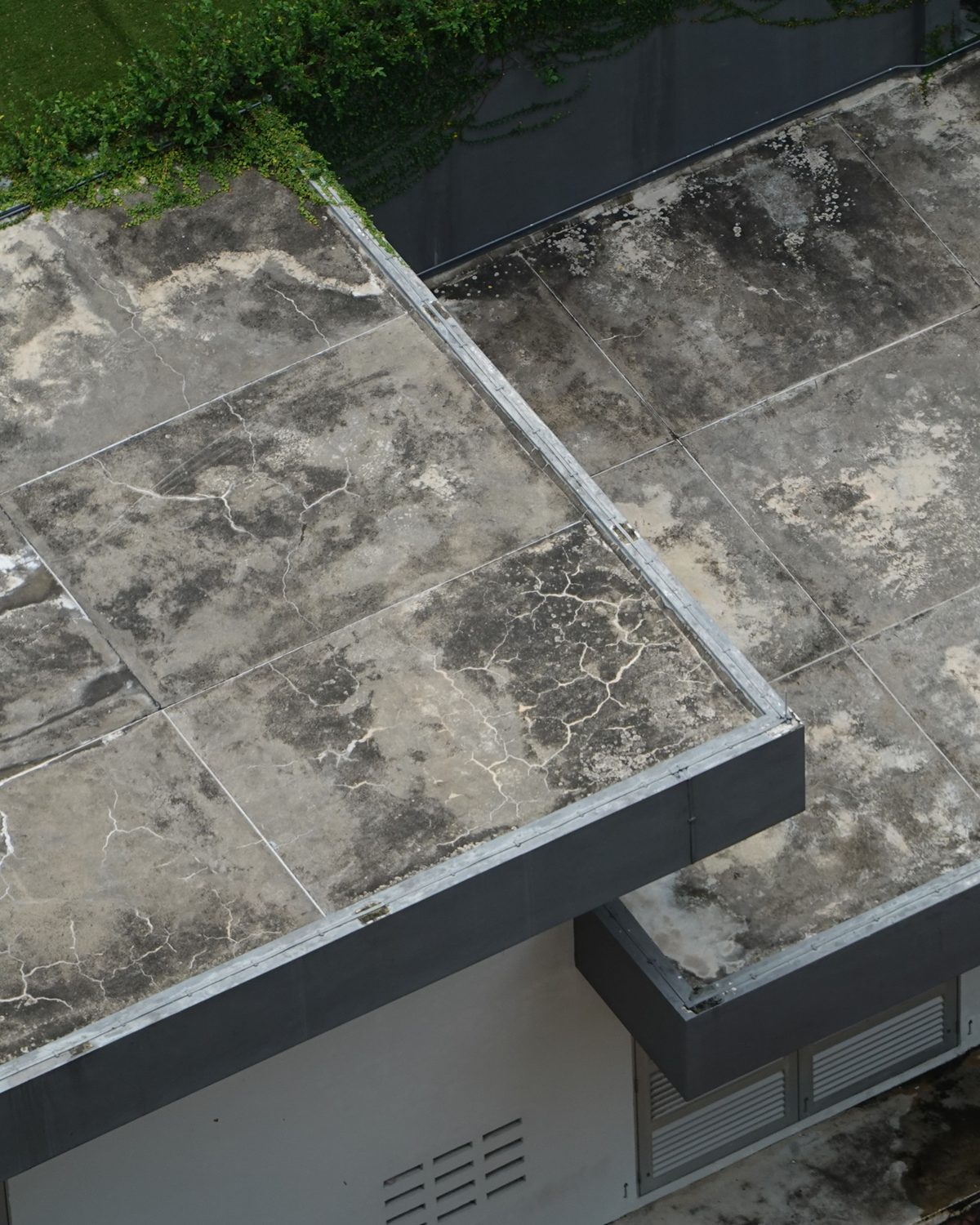
Restoration works on a roof that is worn on top and sound underneath. Whether yours is one is a question of measurement rather than opinion, and it is settled by five tests, most of which take a morning. Our guide to commercial roof restoration sets out what the work involves. This page is about the evidence behind the yes, and about the findings that end the conversation.
The moisture survey, and what its result has to say
The survey is the test everything else waits on, and the methods are described in the questions on our roof coating services page. What matters here is the form of the answer.
A usable result marks the wet areas as areas on a roof plan, names the method used, and records the date and the weather. Those last two are not bureaucracy. An infrared scan reads heat held by damp material after sunset, so it depends on there having been sun, on timing, and on what is on the surface. A sentence in an email saying the roof scanned dry is not a result, because there is no way to check it later or to compare it with next year’s.
What the survey cannot tell you is how long the water has been there, or what the deck under it looks like. Both of those need something cut open.
Cores, and what they show that a scan cannot
A core is a small plug cut through the whole assembly and then made good the same day. Three or four of them, chosen from the scan result rather than at random, answer questions a scan never reaches.
How many roofs are up there, because a second or third roof changes every calculation. What the deck is made of and what condition it is in. What the insulation is, and whether it is a type that holds water or one that sheds it, which decides whether a wet area can be dried or has to come out. And whether there is a vapor retarder in the assembly that is keeping water in place under a membrane that looks sound.
Cores are definitive where they are cut and tell you nothing a few feet away, which is why they confirm a scan rather than replace one.
The adhesion test
A test patch of the proposed system, applied to the actual roof in its actual condition, left to cure and then pulled, answers the one question no data sheet can: whether the coating will bond to this surface.
It is not optional on a roof that has been coated before, on one whose history nobody has, or on one where repairs have been made with mastics and tapes smeared across a single ply. Any of those can leave a surface that the new system will lift off, and the place to find that out is a small square before the order, not the whole roof afterward.
The membrane and its terminations
Three checks, all of them quick. A small cut sample flexed by hand shows whether the membrane has gone brittle, and a membrane that cracks when bent is not going to follow a coating through another decade of movement. Seams probed with a blunt tool show whether the laps still have integrity or are opening along their length. And the terminations at curbs, walls and corners show whether the membrane is shrinking.
Shrinkage is the finding that stops the discussion. A membrane pulling itself away from the perimeter is under a load that does not go away when a surface is applied over it, and the coating is simply dragged along with it.
The view from below, and the roof after rain
Lift the ceiling tiles and look at the underside of the deck. Corrosion, staining patterns, deflection, fasteners backing out and daylight at laps are all visible from inside, in an occupied building, without access equipment. It is the cheapest test on this list and the one most often skipped.
Then see the roof wet. Visit during rain or the morning after, photograph where water stands, and check the drains are actually the low point. Water standing over a bay that deflects under load is a structural finding rather than a drainage one, and it rules restoration out until it has been looked at properly.
What rules restoration out
- Wet insulation across the field rather than in isolated areas
- A membrane shrinking away from curbs, walls and terminations
- A membrane that cracks when a sample is flexed
- Deck corrosion, deflection, or fasteners no longer holding
- Ponding caused by deflection rather than by drainage
- A surface the proposed system will not bond to without preparation that approaches replacement cost
- The same areas repaired repeatedly and still failing
What the report should hand you
Ask for the plan with the wet areas drawn on it, the method and date of the survey, the core results, the adhesion test result, the repair schedule those findings imply, and a plain recommendation with the reasoning written down. That document is what you compare quotes against, and it is what tells you honestly whether you are choosing between restoration and replacement or only being offered the choice. If the answer comes back as no, roof coating versus replacement sets out what follows.
Common questions
How much of the roof has to be dry to qualify?
There is no fixed share, and anyone quoting one is quoting a rule of thumb rather than your roof. What decides it is how much wet material has to come out and what that costs.
- Isolated wet areas are normal on an older roof and are cut out and replaced
- Where the wet areas sit matters as much as how many there are
- Wet material along a whole edge or over a bay suggests a cause, not an accident
- The test is the removal cost against the cost of replacing the same area
Ask for the wet areas to be drawn as areas on a plan and for the removal to be priced as its own line. Once you can see that number beside a replacement price, the decision usually makes itself without anyone needing a percentage.
How old is too old for a roof to be restored?
Age is not the test. A maintained roof well into its life can be an excellent candidate, and a neglected younger one can already be past it.
- Condition and moisture decide it, and both are measured rather than estimated
- What age tells you is how much service life is left to protect
- Late in life the years bought have to be worth the preparation
- Manufacturers may still decline to warrant a system over a very old membrane
Age is useful for planning rather than for deciding. Have the roof surveyed for moisture once it is past the midpoint of its expected life, because the window for restoration opens and closes quietly and most owners find it after it has shut.
Is there any test that can be done from inside the building?
Yes, and it is the cheapest one available. Lifting ceiling tiles and looking at the underside of the deck tells you things no rooftop survey can.
- Corrosion on a steel deck shows from below long before it shows above
- Staining patterns reveal where water has been traveling
- Deflection, backed out fasteners and daylight at laps are all visible
- It can be done in an occupied building with no access equipment
Ask for it as part of any survey and go along. A deck that is rusting from underneath is a replacement conversation whatever the membrane looks like from the roof, and finding that out costs an afternoon and a stepladder.
Should the survey be done by the contractor who would do the work?
It can be, provided you get the evidence rather than the conclusion. The risk is not dishonesty so much as a survey scoped to support the remedy already in mind.
- Ask for the plan, the method, the core results and the photographs
- A recommendation with no evidence behind it is a sales visit
- Where the answer is expensive, a second opinion is reasonable
- An independent surveyor costs more and sells you nothing afterwards
The practical safeguard is to ask the same questions of both quotes and see whether the evidence matches. Two contractors who have both scanned the roof will usually agree about where it is wet, even when they disagree about what to do next.
What happens if two of the tests disagree?
Treat the disagreement as the finding and resolve it before deciding anything. A scan and a core that contradict each other usually mean the scan was read in the wrong conditions.
- Infrared depends on weather, timing and the surface it is reading
- A meter reading depends on where the grid points fell
- A core is definitive at one point and tells you nothing a yard away
- The answer is more cores, chosen where the methods conflict
Do not average the results and do not accept the more convenient one. The cost of cutting two more cores is trivial beside the cost of coating a wet roof, and a surveyor who is confident in the reading will not object to confirming it.