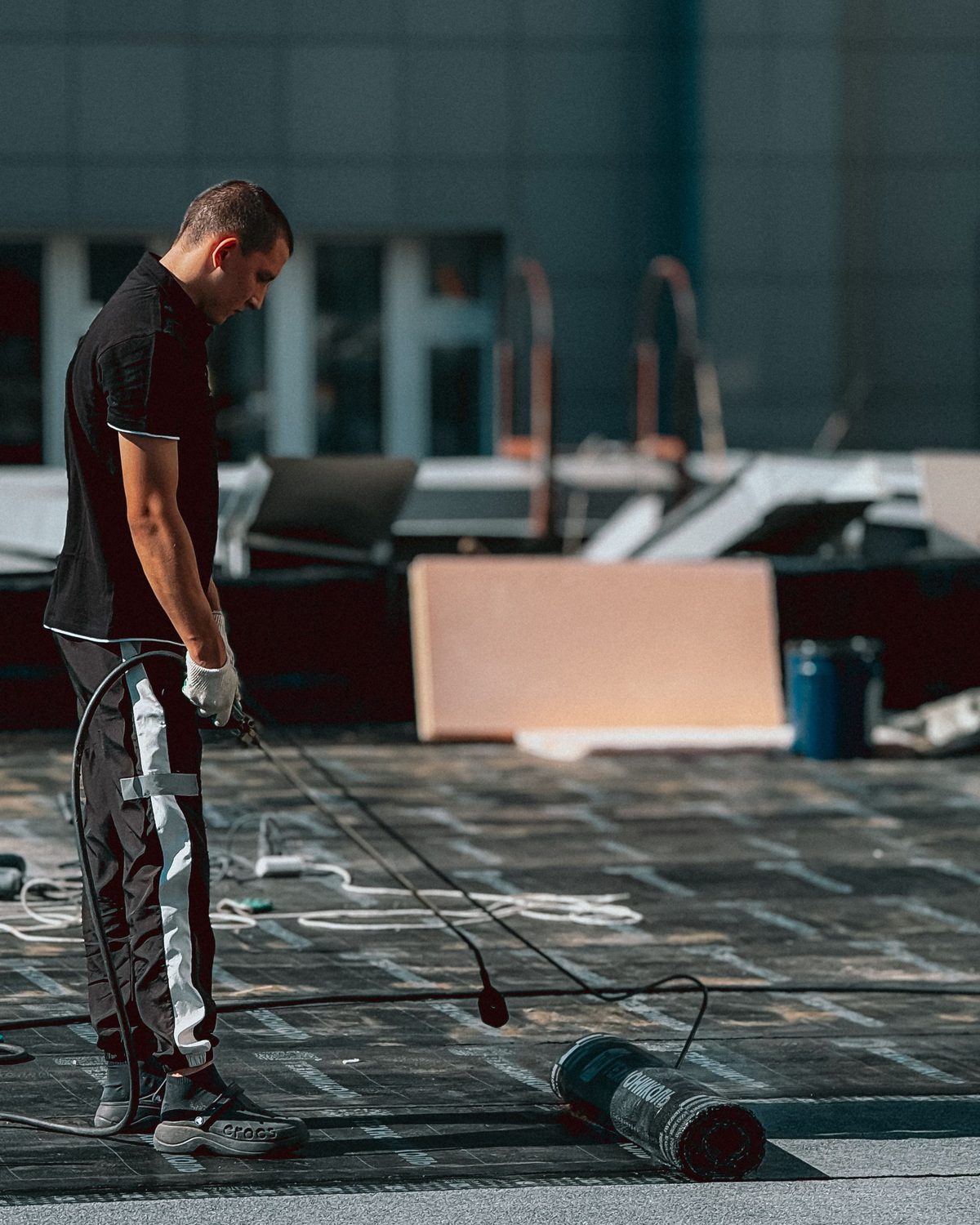
Commercial roof restoration renews an ageing roof without tearing it off. The crew surveys the roof, repairs the damaged areas, replaces the wet sections, rebuilds the details and applies a new surface, usually a coating system, over the existing membrane. The result is a watertight roof with a fresh service life, delivered without the cost, waste and disruption of a replacement.
It sits between repair and replacement, and that is exactly the gap most owners are stuck in. A roof that leaks in one place needs a repair. A roof with wet insulation across the field needs replacing. A roof that is weathered, tired and starting to cost money in call outs, but still sound underneath, is the one restoration was designed for.
Restoration versus replacement
| Restoration | Replacement | |
|---|---|---|
| Existing roof | Stays in place | Removed or covered |
| Disposal | Minimal | Often significant |
| Disruption | Usually lower | Higher |
| Weather exposure during work | None, the roof stays closed | The deck is open in stages |
| Deck and insulation problems | Only isolated areas addressed | Fully accessible and correctable |
| Candidate roofs | Aged but sound, mostly dry | Any, including failed roofs |
| Accounting treatment | Often an operating expense | Usually capital |
The last row is worth raising with your finance team early, because it changes the conversation. A restoration that can be treated as maintenance spending competes with a different budget from a capital replacement project, and that difference sometimes decides which one actually happens. Confirm the treatment with your own accountant rather than with the contractor.
Is your roof a candidate
A roof is a good candidate when:
- Most of the insulation is dry, confirmed by a moisture survey or core samples
- The deck is sound, with no soft spots, corrosion or movement
- The membrane is weathered but not failing across the field
- Leaks are isolated and repairable
- Drainage works, or the low spots can be corrected as part of the work
- The roof type and condition are ones the coating manufacturer will warrant
A roof with widespread wet insulation or deck damage usually needs replacement instead. So does one that has been patched repeatedly in the same areas and is still leaking, or one whose membrane is brittle, crazed or shrinking away from the perimeter. Shrinkage in particular is a hard stop, because a coating cannot restore a membrane that is pulling itself off the walls and curbs.
The survey is the part to insist on. A contractor who quotes restoration from a walk around the parapet, or from an aerial photograph, has not established the one fact the decision rests on. Ask for the wet areas to be marked on a roof plan, and ask how they were identified: infrared, capacitance meter, or core samples cut and made good.
The restoration process
- Survey and moisture scan. The condition of the membrane, the details and the insulation is recorded, and the wet areas are mapped.
- Remove and replace wet areas. Saturated insulation is cut out and new material installed, with the membrane made good over it.
- Repair seams, flashings and penetrations. Every detail is brought back to sound condition, because these are where the roof will leak next.
- Correct the drainage. Drains are cleared and reset, and standing water is addressed rather than coated over.
- Clean and prime the surface. Usually a pressure wash with an approved detergent, then a primer where the system requires one.
- Reinforce the moving joints. Fabric or tape is embedded in the coating at seams, corners and transitions.
- Apply the coating system at the specified thickness, in the number of coats the manufacturer calls for.
- Final inspection and warranty registration, with thickness readings and photographs recorded.
Steps two to four are the restoration. Step seven is the part everyone talks about. A quote that is heavy on the coating and vague about the preparation is quoting a paint job.
What restoration does not solve
Restoration renews a surface and the details around it. It does not add insulation value, correct a deck that was never right, fix a roof built to the wrong falls, or cure a building with a condensation problem. If water is appearing on ceilings in cold dry weather rather than in rain, the cause is probably not the roof at all, and restoring it will not help.
It also does not repair a roof that is still leaking. Everything wet has to come out and every active leak has to be fixed before the new surface goes on, which is why leak tracing usually comes first in the sequence.
Restore it before you need to
Restoration has a window, and most owners find it after it has closed. The roof that restores well is the one that is not yet in trouble: weathered on the surface, dry underneath, leaking rarely and cheaply. Wait until it is leaking monthly and the same roof has moved into the replacement category, because by then the water has been in the insulation for seasons.
This is the opposite of how roof spending usually works. Money arrives when something fails, and by the time it fails the cheap option has expired. The practical answer is to have the roof surveyed for moisture while it is still behaving, typically once it is past the midpoint of its expected life, and to know from that survey whether restoration is on the table and for how long. A roof inspected on a maintenance program gives you that warning without a separate exercise.
Metal roofs are a different case
Low slope metal roofs restore particularly well, because their usual failure is not the panel. It is the fasteners, the washers under them, the seams and the laps, all of which can be repaired and then covered by a continuous surface. Restoring a metal roof normally means replacing failed fasteners, treating rust, sealing the seams with reinforced detail work, and coating the whole roof so that the hundreds of individual penetrations become one surface.
Two conditions decide whether it is worth doing. The panels must have enough sound metal left, so heavy perforation or rust through means replacement rather than restoration. And the substrate must be prepared properly, which on metal means removing loose rust and using the primer the system specifies. A coating over untreated rust will lift, and it will take the coating around it with it.
Comparing quotes honestly
Ask every restoration quote for the same four things, and the comparison becomes easy:
- The moisture survey results, with wet areas marked on a plan and the method stated
- Preparation and repair priced separately from the coating
- The manufacturer’s system name, the number of coats and the specified dry film thickness
- The warranty tier offered, and who issues it
Then price a replacement on the same roof. Restoration usually wins on a sound roof by a comfortable margin. On a tired one, the repair schedule grows until the saving disappears, and the quote that looked cheapest turns out to be the one that skipped the survey.
Keeping what you paid for
A restored roof is a new surface on an old assembly, and it needs the same care as any other roof. Clear the drains, keep service technicians on walkway protection rather than on the coating, and inspect it on a schedule with records, which most warranties require in any case.
Restoration works best when it is followed by regular maintenance. That is what carries the roof to its recoat date, at which point the cycle can often start again rather than ending in a replacement.
Not sure whether your roof qualifies? Start with a moisture survey. Weighing the surface options instead? Read our guide to roof coatings.
Common questions
Is restoration cheaper than replacement?
Usually, and often by a wide margin, because the existing roof stays in place: little tear off, little disposal, no new deck work and far less disruption to the building.
- The saving is real only when the roof is genuinely a candidate
- A moisture survey decides that, not a sales visit
- Cost is driven by how much repair is needed before the new surface goes on
- Wet insulation, rebuilt details and a reset drain push it toward a new roof's price
At that point you are paying replacement money without a replacement's service life. Ask for restoration to be quoted with the preparation and repair separated from the coating, then price a replacement for the same area and compare each option against the years it buys.
Can a restored roof carry a warranty?
Yes. Most coating manufacturers offer warranties on restoration systems, issued after their own inspection and only where the work is done by a contractor they have approved.
- A material only warranty replaces the product, which is rarely what fails
- It excludes everything caused by preparation, which is the usual cause of failure
- A labor and material warranty from the manufacturer is the one with real content
- Its conditions: documented thickness, an authorized contractor, inspections and records kept
Ask to see the warranty document before work starts rather than after, and read the exclusions, which commonly include ponding water, damage from rooftop equipment and unauthorized repairs. A warranty you cannot comply with is a marketing line, not protection.
How many years does restoration add to a roof?
Enough to change a capital plan, if the roof was a good candidate and the work was done to specification. It buys a further service interval, after which the roof can often be recoated rather than replaced.
- Restoring a roof that was already failing buys very little, whatever the system
- A coating applied thinner than specified fails early and voids the warranty
- A restored roof that is inspected and kept clear of traffic reaches its recoat date
- One that is forgotten does not
Treat the years gained as a planning tool. Restoration is most useful when you know what you are buying time for, such as a lease running to a known date, a sale, or a replacement that needs to sit in a later budget year.
How disruptive is a roof restoration to the building below?
Much less than a replacement. Nothing is torn off, so there are no open decks, no skips of wet insulation and no fasteners driven into the deck above occupied space.
- For most tenants the building runs normally while restoration happens overhead
- Coatings have cure requirements, so the program moves with the weather
- Solvent based systems carry odor, so air intakes may need covering and tenants telling
- Pressure washing means protecting rooftop equipment and managing water discharge
- Rooftop plant may need short shutdowns while the area is prepared and coated
None of that is difficult, but it is much easier agreed in advance than discovered on the morning the crew arrives. Ask for a program naming the access route, the working hours, the cure periods and any shutdown, and share it with your tenants before work starts.
Can a roof be restored more than once?
Often yes, and that is much of the appeal. A roof approaching the end of its coating cycle can usually be cleaned, spot repaired and given a fresh top coat.
- Each cycle is cheaper and less disruptive than the replacement it defers
- Compatibility limits it: the new coating has to bond to the old one
- Very little adheres reliably to weathered silicone except more silicone
- Restoration renews surfaces and does nothing for wet insulation or a corroded deck
Every recoat should be preceded by the same moisture survey as the first one. When that survey comes back showing wet material across the field, the cycle has ended and the honest answer is replacement rather than another coat.