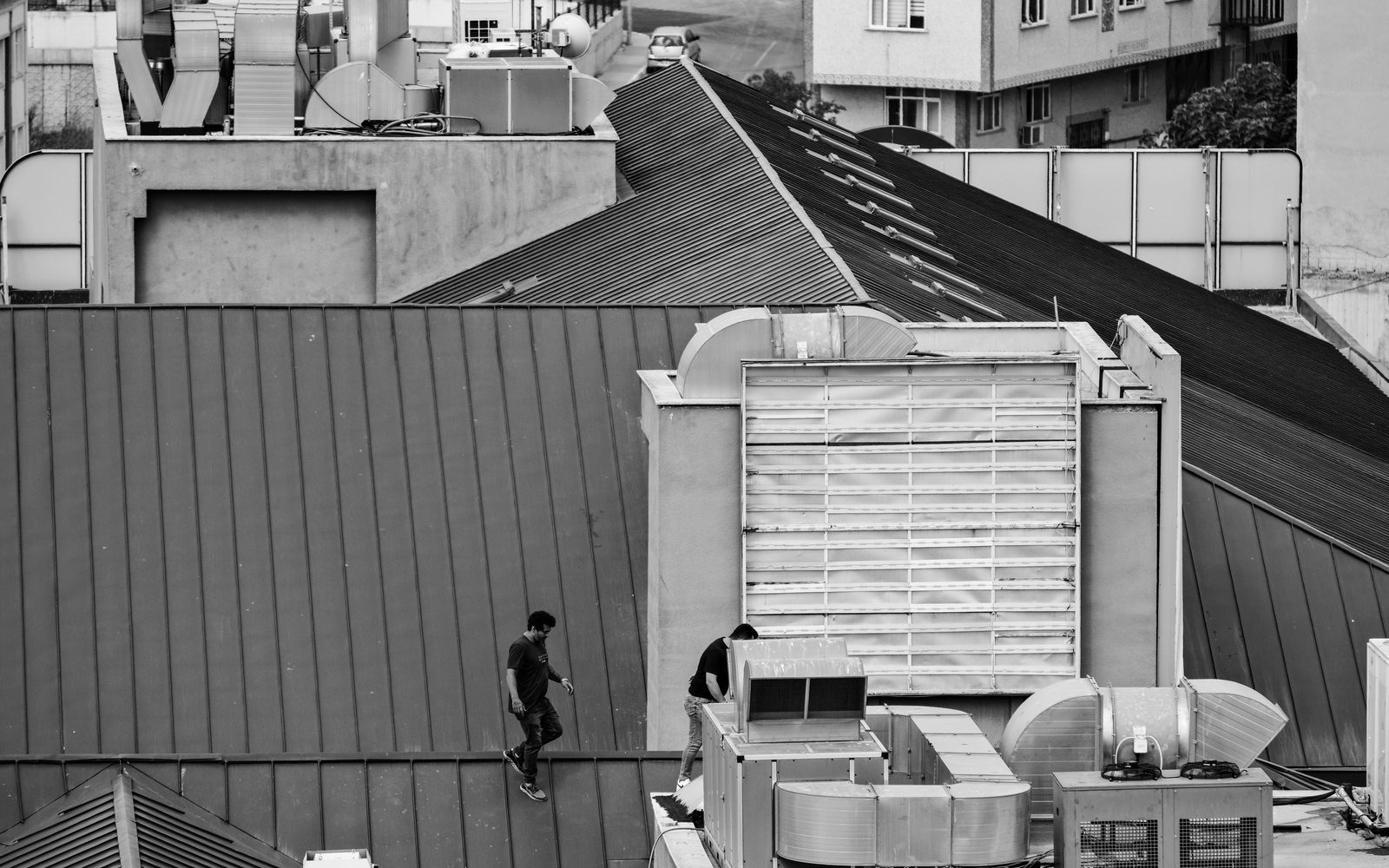
Flat roof maintenance is the routine work that keeps water moving off a low slope roof and away from the details that cannot take it standing. On a pitched roof, gravity does that in minutes. On a flat roof it is done by a designed path of falls, sumps, outlets and overflows, and maintenance is mostly the work of keeping that path open and the handmade details around it sound.
That difference decides everything else. A pitched roof is maintained by looking at its covering. A flat roof is maintained by following its water, and almost every finding worth having comes from asking where the water goes, how long it takes to get there, and what it sits on while it waits.
Why a low slope roof is maintained differently
Three things are true of a flat roof and not of a pitched one, and each of them creates work.
Water leaves slowly. A shallow fall moves water at walking pace at best, and any obstruction stops it. A silted sump, a strainer packed with leaves or a slightly settled area is enough to hold a pond for days over a seam that was only ever designed to be wet during rain.
Everything stays where it lands. Leaves, grit, packaging, the washers from somebody’s bracket, the offcuts from a cable run: on a pitched roof most of that blows or washes off. On a flat roof it collects in the corners, along upstands and against every curb, which is exactly where the drainage path and the details are.
People use it. A flat roof is a floor. Plant sits on it, technicians walk it and contractors stage materials on it, and in most buildings nobody records any of that.
The drainage path, end to end
Maintenance on a low slope roof starts at the outlet and works outwards. Walk the path in this order and the visit has a structure rather than a wander.
| Part of the path | What to check | What a problem looks like |
|---|---|---|
| The field | That water is moving toward the outlets and not away from them | Dirt lines, silt deposits or growth marking where water stops |
| Sumps | That the sump is clear and the membrane around it is bonded | Silt, standing water in the sump between rains, a lifted lap at the rim |
| Strainers and domes | That each one is present, secure and not packed | A missing dome, a dome full of leaves, a strainer wedged with debris |
| Clamping rings | That the ring is tight and the membrane is gripped evenly | Loose or missing bolts, membrane pulled away, sealant used as a repair |
| Scuppers and through wall outlets | That the throat is clear and the flashing is sound | Staining down the outside wall, debris held behind the opening |
| Overflows | That they exist, are clear, and are set above the primary outlet | No overflow at all, or one blocked or set at the wrong height |
| Gutters and downpipes | That the fall runs and the outlet at the bottom is open | Water marks above the gutter line, a dry pipe in heavy rain |
Silt is the item most often missed. Leaves are visible and get cleared. The fine grit that washes off a surfacing and settles in a sump is not, and it narrows the opening a little more every season.
The overflow deserves a separate mention because it is the one part of the path nobody watches. It is there to protect the structure when the primary outlet fails, which means the day it is needed is the day nobody has checked it for years. It is also diagnostic: if an overflow has been running, the primary outlet was blocked, and you now know something the roof was not going to tell you any other way.
Reading the surface between visits
A flat roof records its own history, and most of it is legible to anyone who knows what to look at.
- Tide marks. A clean line of silt or staining marks the edge of water that stood there, so you learn how large the pond gets without being on the roof in the rain.
- Dirt patterns at seams. A seam that holds a line of dirt is a seam with a slight step or an edge that has lifted. It is worth probing before it is worth worrying about.
- Granule or surfacing loss. Bare patches on a mineral surface, or chalky residue on a coating, show where the weather has done most work. Under an equipment discharge, the cause is the equipment.
- Footprints and scuffs. A worn route is a map of where people walk. Follow it to the unit they are walking to, and to the punctures on the way.
- Growth. Anything green marks a place that stays damp. It is a drainage finding first and a cleaning job second.
None of that needs equipment. It needs somebody to walk the roof with their eyes down and write what they saw.
The maintenance year on a flat roof
The calendar matters less than the events, but a flat roof has a natural rhythm.
| When | The work |
|---|---|
| After leaf fall | Clear every outlet, sump, gutter and overflow. This is the single most valuable visit of the year |
| Before the wet season | Confirm the path is open end to end and that the overflows are clear |
| After the first heavy rain | Walk it a day or two later and mark where water is still standing |
| After a freeze | Check details, terminations and any area that held water for splits and lifted edges |
| After high wind | Check edge metal, coping joints, anything loose and anything that has arrived from elsewhere |
| After any trade has been up | Check what they left, what they fixed through the roof and where they walked |
That last row is worth enforcing rather than hoping for. A flat roof is the easiest place in a building to work and the easiest place to do damage without noticing.
Traffic, equipment and the things bolted to the roof
On most commercial buildings the rooftop is a plant room with a membrane for a floor. That means maintenance has to cover the interface between the two, which is nobody’s contract by default.
Check that condensate discharges onto a protected surface rather than straight onto the membrane, where it wears a patch and keeps it damp. Check that access panels are closed. Check that ballast blocks, feet and stands still sit where they were put. Check the route from the hatch to each unit and protect it where the membrane shows wear, because the alternative is repairing the same punctures every year.
Where the building has an array or a screen, agree in advance who is allowed to move what. A crew that cannot lift a panel cannot inspect under it.
What flat roof maintenance will not fix
Maintenance keeps a sound roof sound. It does not correct a roof built without enough fall, add an outlet where the design never had one, dry insulation that is already wet, or cure a membrane that is shrinking away from its upstands. Those are construction problems, and treating them as maintenance means paying every year for a condition that never improves.
The honest test is whether a finding keeps coming back in the same place after being corrected. A drain that blocks every autumn is maintenance. An area that ponds every time it rains, however often the drain is cleared, is a flat roof repair question about the water path itself. Our guide to roof maintenance covers the point at which maintenance stops extending a roof’s life and starts holding a line.
Keep the record on a plan, not in a folder
A flat roof is a plan rather than an elevation, which makes it easy to record properly. Number the areas, mark the outlets, and put every finding on the same drawing every time. Date it. Photograph the same positions from the same places, and photograph anything new twice: once wide enough to show where it is, once close enough to show what it is.
The value is comparison. A single report describes a day. A run of them on one drawing shows direction: which areas are getting worse, which are holding, and where the money has actually gone. That is the difference between a record and a receipt.
Working out how often? Read how to build a roof maintenance plan. Walking the roof yourself? Take the roof maintenance checklist with you.
Common questions
Does a flat roof need different maintenance from a pitched roof?
Yes. A pitched roof sheds water by gravity in minutes, so its maintenance is mostly about the covering. A flat roof holds water until a designed path removes it, so its maintenance is mostly about that path.
- Outlets, sumps, strainers and overflows are the first thing checked
- Water that cannot leave sits on seams and flashings for days
- Everything stored, walked on or bolted down stays on a flat roof
- Debris that blows off a pitched roof collects in the corners of a flat one
The practical result is that a flat roof rewards frequent short visits more than an occasional thorough one. Most of what shortens its life is a blockage or a small opening that costs minutes to correct and seasons to repair once water has been through it.
How do I know if my roof drains are working?
Watch the building during rain rather than the roof. Every outlet has a downpipe or a discharge point somewhere at ground level, and a drain that is running shows there.
- Note which outlets discharge and which stay dry in the same downpour
- A dry pipe during heavy rain means a blockage above it
- Water running from an overflow means the primary outlet has failed
- Check the roof again a day or two after rain has stopped
Standing water at that point marks where the path is not working, whether or not the outlet itself is clear. Photograph the area with something in shot that shows scale and position, because the same pond in the same place next year is a different finding from a new one.
Should vegetation and moss be removed from a flat roof?
Yes, on any roof not designed to carry planting. Growth means organic matter and moisture have been sitting long enough for seeds to germinate, which is a drainage finding before it is a cleaning one.
- Roots work into laps, upstands and the joints around outlets
- The mat holds water against the membrane long after the roof has dried
- Removal is done by hand, not with a scraper or a wire brush
- Pressure washing can drive water into an open seam and cut a coating
Treat the growth as a symptom and find out why that spot stays damp. Clearing it and leaving the cause means the same patch is green again by the next season, and each cycle has been quietly working at the detail underneath.
Does snow need clearing from a flat roof?
Sometimes, and it is a structural question rather than a roofing one, so it is answered by an engineer who knows the building rather than by a roofer with a shovel.
- Snow load matters most where it drifts against parapets, walls and equipment
- Drifts are deeper and heavier than the depth across the open field suggests
- Keeping outlets and overflows open matters more than removing snow
- Melt water with nowhere to go refreezes and backs up over flashings
If clearing is needed, it is done with plastic tools and without scraping down to the membrane, and it is done by people equipped to work on a slippery roof with the edges hidden. Never use salt or chemical melt on a membrane unless the manufacturer says which product is acceptable.
Do solar panels make a flat roof harder to maintain?
Yes, in three ways: they cover the membrane, they add traffic, and they concentrate debris. None of that is an argument against solar, but it changes what maintenance has to include.
- The membrane under and between arrays still has to be reachable and inspected
- Debris collects along the upwind edge of every row
- Ballast blocks and feet wear the surface where they sit and shift
- Cable trays and conduit add penetrations or bearing points to check
Agree access with whoever maintains the array before the first visit, because panels are theirs and the roof is yours, and neither crew should be moving the other's work unsupervised. Ask for the array layout on the same roof plan the maintenance findings go on.