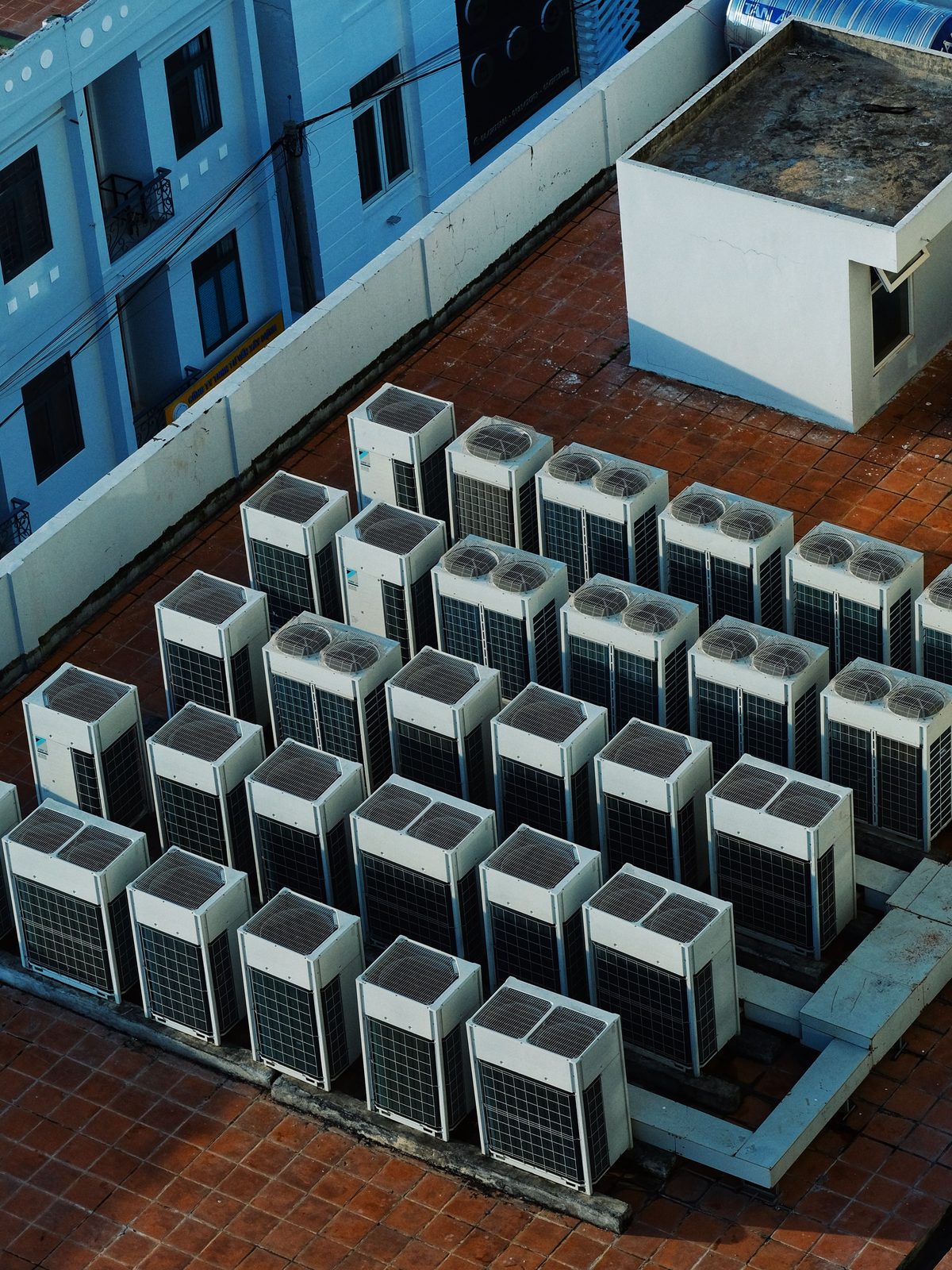
This is a checklist for a routine walk of a flat or low slope commercial roof. It is written to be used rather than read: five sections, each a list of what to look at and what a problem looks like.
It does not replace an inspection by a roofer. It is what a facilities team can do between professional visits, so the professional visit starts from something rather than from nothing.
Before you go up
Do not go up alone, in wet, windy or icy conditions, or where the roof cannot be reached safely. Know where the edges, the skylights and any fragile areas are before you step out. If the building has a permit system, use it, and log the visit either way.
Take a camera, a numbered roof plan, the last report and something to write on. Take nothing that can be put down and left behind.
The surface
| Look at | What a problem looks like |
|---|---|
| The open field of the membrane | Splits, cuts, punctures, scuffs, anything that has been dropped and left |
| Blisters and bubbles | Raised areas, soft underfoot, growing compared with the last photograph |
| Surfacing | Bare patches where granules or gravel have gone, chalky residue on a coating |
| Color and texture | Areas noticeably darker, harder or more brittle than the rest of the roof |
| Walkways and traffic routes | Worn pads, missing pads, wear on the membrane where people cut the corner |
| Anything green | Moss, weeds or organic matter, marking a spot that stays damp |
| Loose material | Stones off the ballast line, offcuts, packaging, fixings, washers, tools |
The details
This is where roofs leak. Every item here is handmade, which is why it fails first.
| Look at | What a problem looks like |
|---|---|
| Seams and laps | An edge you can lift, a line of dirt along the seam, a visible step, anything sealed with mastic |
| Upstands at walls and parapets | The membrane pulling away from the wall, a gap at the top, a slumped corner |
| Terminations and edge trim | Loose or missing fasteners, a bar that has lifted, sealant that has cracked or fallen out |
| Coping and edge metal | Open joints, lifted sections, staining down the wall beneath a joint |
| Curbs around units | Gaps at the corners, a flashing that has slipped, fixings driven straight through the membrane |
| Pipe boots and collars | Splits at the top, clamps missing, the collar standing away from the pipe |
| Penetrations and supports | Anything bolted, fixed or resting directly on the membrane without a proper detail |
| Skylights and hatches | Cracked domes, failed seals, flashing lifted at the corners, a hatch left open |
The drainage
Do this section first if the roof is wet: standing water explains most of what you find elsewhere.
| Look at | What a problem looks like |
|---|---|
| Outlets and sumps | Leaves, silt or debris in the sump, water still sitting in it between rains |
| Strainers and domes | Missing, broken, loose or packed solid with debris |
| Clamping rings | Bolts loose or missing, the membrane not gripped evenly all round |
| Scuppers and through wall outlets | A blocked throat, damaged flashing, staining down the outside wall |
| Overflows | None present at all, blocked, or evidence that one has been running |
| Gutters and downpipes | Debris, sagging, water marks above the gutter line, a joint that has opened |
| Standing water | Water still present a day or two after rain, or a tide mark showing where it stood |
| The fall | Water running away from an outlet rather than toward it |
The equipment
Most rooftop equipment belongs to somebody else and sits on your roof. Check the interface.
| Look at | What a problem looks like |
|---|---|
| Condensate discharge | Water running straight onto the membrane, a permanently damp patch, staining |
| Unit bases and stands | Feet bearing directly on the membrane, pads that have moved, rust staining |
| Access panels and covers | Panels open, missing, or propped rather than fastened |
| Cable trays and conduit | Runs resting on the membrane, fixings through the roof, cables under foot traffic |
| Solar arrays and screens | Debris packed along the upwind edge, ballast blocks that have shifted, worn membrane under a foot |
| Ductwork and extract | Loose sections, grease staining around a kitchen extract, damage to the surface below it |
| Evidence of recent work | New fixings, offcuts, sealant, footprints or scuffs on a route you do not recognize |
The interior
The inside of the building reports on the roof, often earlier than people expect.
| Look at | What a problem looks like |
|---|---|
| Ceiling tiles and finishes | New stains, a stain that has grown, a tile that has sagged or fallen |
| Above the ceiling, where safe | Damp on the deck, rust lines, drips running along a beam or a duct |
| Walls below upstands | Damp patches at high level, blown plaster, staining at a corner |
| Light fittings and services | Water near a fitting, which is an immediate safety issue rather than a roof finding |
| Insulation in the void | Damp, compressed or stained material |
| What the occupants say | A drip somebody mopped up and never reported, a smell of damp, a recurring puddle |
Water on a ceiling in cold dry weather, spread over an area rather than dripping in one place, is more often condensation than a leak. Record the conditions either way.
What to do with it
The checklist is worth nothing on its own. What matters is what happens afterwards.
- Photograph everything you find. Twice: wide enough to place it, close enough to see it.
- Date it. Without a date you have a picture of a roof.
- Mark it on the plan. The same numbered areas every time, so somebody else can find it.
- Rate it. Fix now, fix this year, or watch, with the reason written beside it.
- Keep it where it will survive staff turnover. A record held in one person’s inbox leaves when they do.
- Compare it with the last one. This is the whole point. One walk is a snapshot. A run of them shows what is changing, and what is changing is what deserves the money.
Send anything rated fix now to your roofer the same day, with the photographs and the location. The rest goes into the next scheduled visit.
Want the reasoning behind these checks? Read flat roof maintenance. Putting it on a schedule? Build a roof maintenance plan.
Walked by Date Roof
Common questions
In what order should a roof be walked?
Drainage first, then the perimeter, then the details, then the open field, and finish inside. The order matters because the first two usually explain most of what you find afterwards.
- Standing water and blocked outlets set the context for every other finding
- The perimeter carries the details that fail earliest
- Walking the field last means you are not crossing it repeatedly
- Use the same route every time so nothing is quietly skipped
Write the route into your own version of the checklist and number the areas on a roof plan. A consistent route is what makes two visits comparable, and comparability is the whole reason for keeping the records at all.
What should we photograph, and how?
Photograph every finding twice: once wide enough to show where it is on the roof, and once close enough to show what it is.
- Include something in the close shot that gives scale
- Include a fixed feature in the wide shot so the spot can be found again
- Repeat the same wide views from the same standing positions every visit
- Check the date is recorded by the camera, and write it down as well
Photograph the things that look fine too, at least the standing views, because the value of a photo log is in the comparison rather than in any single image. A picture of a sound seam today is what proves when it stopped being sound.
How should findings be rated?
On one simple scale used the same way every time. Three levels are enough: fix now, fix this year, watch.
- Fix now means water is getting in or is about to
- Fix this year means it will fail if left but is not failing yet
- Watch means record it, photograph it and compare next visit
- Never invent a fourth level for a finding you do not want to argue about
Write the reason next to the rating, not just the rating. A finding marked urgent with no reasoning is the first thing a budget holder overrules, and a finding marked watch with no reasoning is the one that gets forgotten until it is not watchable any more.
What do we do with a finding nobody can identify?
Record it exactly as you found it, photograph it properly, mark it on the plan and send it to your roofer. Do not guess, and do not poke at it to find out.
- Note what it looks like, where it is and what is nearest to it
- Note the weather and whether the roof was wet
- Do not lift, cut, peel or probe anything to investigate
- An unexplained finding near a detail is more urgent than one in the open field
Most of what people cannot identify turns out to be ordinary: a repair somebody made, a survey core, a change of material. A few turn out to be the beginning of something. Either way the photograph settles it in a minute and a guess never does.
Should every roof use the same checklist?
The structure should be the same. The detail should not. Sections, systems and what sits on the roof all change what is worth looking at.
- A ballasted roof hides its surface, so the checks shift to the perimeter and outlets
- A metal roof spends most of its checklist on fasteners, laps and penetrations
- A roof with an array needs the array route and its bearing points added
- A roof with kitchen extract needs the grease path checked every visit
Keep the five sections below as the frame and add the rows your roof earns. Across a portfolio, use one format and one rating language, because the point of a common structure is that two buildings can be compared rather than merely described.